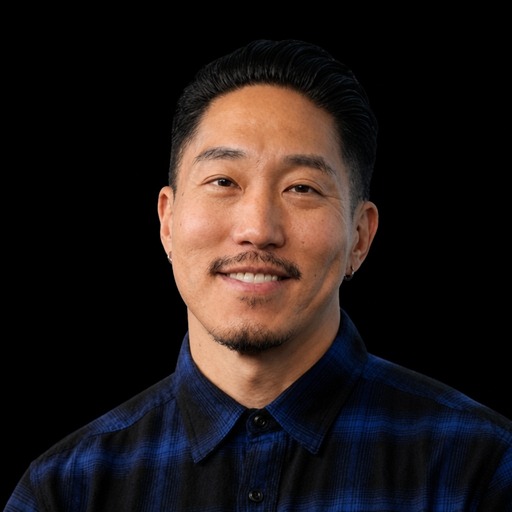
Tad Nakamura spent seven years making Third Act, which premiered in the U.S. Documentary Competition at the 2025 Sundance Film Festival. It’s a film about his father, Robert A. Nakamura, the man generations of filmmakers call the Godfather of Asian American media, and whom Tad simply calls Dad.
Everything was set up for me, I just had to step up to the plate, but I could still strike out.
A Family Whose Tradition Is Film
Tad grew up the son of a filmmaking team, his father directing, his mother Karen Ishizuka producing, in a house where the garage was an edit bay and family vacations were really production shoots. The young Justin Lin, one of his father’s UCLA students, wrote Better Luck Tomorrow in that garage and shot the gloriously awkward high-school footage of Tad talking about playing college football that turns up in the film. He was taught to stay through the credits. For years he ran from all of it, defining himself as a football-playing, hip-hop-loving jock, until a knee for an easy grade led him to his father’s Asian American Studies class at UCLA, where a combination of images and sound stopped feeling like schoolwork. He’s now made films for two decades, and his earlier ones run about an hour; Third Act is his first ninety-minute feature. The shadow was real, professors who were his dad’s colleagues, an older student once sneering “your daddy teach you that?”, but Tad came to see the shadow clearly: there’s pressure, yes, but there’s also a privilege almost no one else gets.
The Film Only the Son Could Make
The guiding question Tad kept asking was how to make a film that only he could make, one told through a son’s eyes rather than a biographer’s. That meant breaking the wall and showing the process itself, since the structure of Third Act is the making of Third Act: two men talking about the film while driving to a UCLA football game, conversations that would never happen if a stranger held the camera. It also meant something Tad could only do with a half-director, half-son hat on. He and his father aren’t the type to sit at the dinner table and say the loving, difficult things out loud, so the camera became the one place those things could be said. The movie is, in his words, a love letter and a thank-you to his dad, a way of asking everything he ever wanted to know while his father could still tell him everything he wanted Tad to know before it was too late.
That urgency is real. Robert was diagnosed with Parkinson’s during production, and his health declined as the years passed, turning the film into a document of that journey as much as a tribute. Robert’s own story carries the weight underneath all of it: a child survivor of the WWII incarceration of Japanese Americans at Manzanar, a commercial photographer who walked away to tell his own community’s story, and the maker of landmark works like the 1971 short Manzanar and the 1980 feature Hito Hata: Raise the Banner, one of the first features made by and about Asian Americans.
Time Travel, and the Real Inheritance
The seed of the whole project was one of his father’s films.
One of the great things about cinema is it can be a form of time travel.
In 1974, Robert made Wataridori: Birds of Passage, a portrait of three Issei immigrants that included his own father, Tad’s grandfather. Tad had only known his grandfather as an old man who listened to the Dodgers and handed out ice cream, so seeing him on film as a young, powerful Judo master felt like time travel. He wanted to give his own kids that same gift with their grandfather, and the rhyme runs deep: Tad is now about the age his father was when Robert turned a camera on his parent, and Tad’s young son appears in the footage at nearly the age Robert was when he entered Manzanar. Here’s the stance worth drawing out. What Tad inherited wasn’t a career, it was a coping method. Robert handed down the discovery that a family scarred by incarceration, by the shame Robert felt watching his own father diminished, by the silences that calcify between fathers and sons, could metabolize all of it through a lens. So Third Act is Tad doing to his father exactly what his father did to his, turning a parent into footage so that love and grief, which this family cannot speak aloud, can finally be expressed in the one language they share. The make-the-film structure isn’t documenting the relationship; it’s constituting it, building the only room where these two can be fully present to each other. The Parkinson’s lends urgency, but the real race isn’t against death, it’s against the family habit of leaving the important things unsaid. Making it, Tad felt himself shift from identifying mostly as a son to also being a father, the role quietly reversing as he wiped his dad’s brow and worried, the way a parent does, about a man who had always been the one giving the pep talks. The film belongs in conversation with Kirsten Johnson’s Dick Johnson Is Dead, another filmmaker child confronting a parent’s mortality through cinema, and Rea Tajiri’s History and Memory, a touchstone of how the incarceration lives on across generations.
Archival as Feeling, PBS as Home
Tad fell for documentary through archival footage, the 60s and 70s Asian American movement, the long hair and the swagger, the grainy eight-millimeter texture that, like the films themselves, lets him feel he’s living in another time. For an emotional, personal film in which he’s also a character, he leaned for the first time on an outside editor, Victoria Chalk, whose fresh eyes let him stay a viewer of his own story. There were dark moments, points where he feared he’d waited too long, that his father’s decline had outrun the film, but his dad, a master, always talked him back from the ledge with the same wisdom: this won’t be your last film, so it doesn’t have to be perfect.
The path to audiences runs through public media, by design. The Center for Asian American Media and ITVS were early partners and funders, and the film was always slated for PBS’s Independent Lens, the home of so many documentaries Tad reveres, and the platform that carried his father’s work too. He’s clear-eyed that for an independent filmmaker outside a major studio or one of the big streamers, that mainstream pipeline can feel closed off, which is exactly why the public-media ecosystem matters. His parting advice is the lesson the whole film embodies: trust your community and make work for it, because the awards and funding come and go, but it’s the community that sustains a career in the end, just as his father’s did for him. It’s fitting that when the whole family travels to Park City for the premiere, what he looks forward to most is the second half, when his old high-school football teammates, the ones who appear in the film, come up to ground him, the same friends who steadied him at his first Sundance back in 2008.