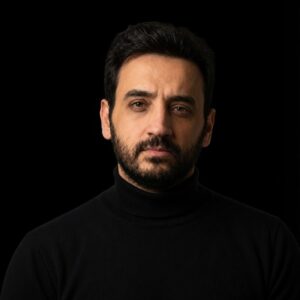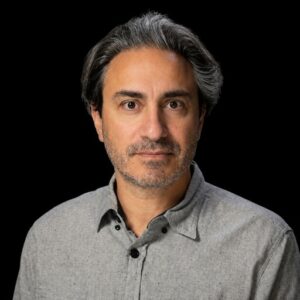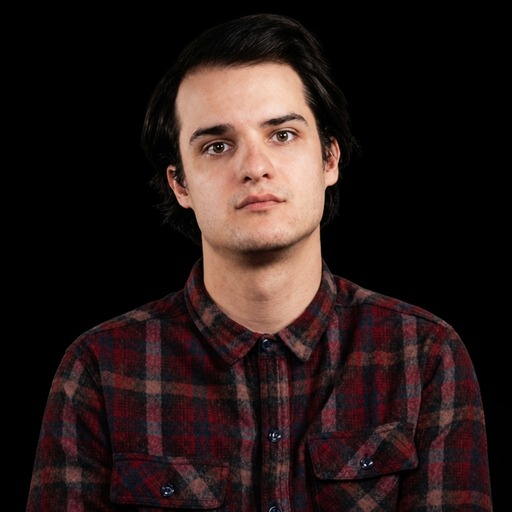
Charlie Tyrell’s first feature, The AI Doc: Or How I Became an Apocaloptimist, co-directed with Daniel Roher (the Oscar-winning director of Navalny) and produced by Daniel Kwan of Everything Everywhere All at Once, premiered at Sundance and is now in theaters from Focus Features. It is a documentary about artificial intelligence, which is to say a documentary about a subject so vast and abstract that most people would honestly rather not think about it at all. The whole film is built to defeat exactly that flinch.
Make It Personal Enough That You Can’t Look Away
Tyrell names the reflex precisely: faced with AI, people want someone to “tell me the one thing I need to know so I don’t have to hear about it again.” That urge to look away is the thing the film is engineered against, and the tool it uses isn’t more information. It’s fatherhood. Roher and Tyrell were both about to have their first children, born within a week of each other, and producer Jonathan Wang suggested they put that into the story.
I’m not going to be able to contribute to a topic unless I feel like there’s something in me, in my lived experience, in my perspective that is going to suit the film.
By routing an unfathomable subject through the specific terror of becoming a parent, the film converts an abstraction you can ignore into a stake you can’t: not the distant question of what AI will do, but the immediate one of what world you are handing your kid.
The Same Instinct, His Whole Career
This is the instinct behind Tyrell’s earlier work. He is best known for the short My Dead Dad’s Porno Tapes, a tender, much-awarded film he made by curating his late father’s belongings, trying to know a man he lost in 2008 through the objects he left behind. He doesn’t make issue films; he makes the place where an issue lives inside a person. Now a father himself, he talks about the fragility of memory, the way a late parent’s voice can start to dissolve as the years pass, and that same tender attention to what’s at risk of being lost is what he brings to a story about the future. So when Kwan and Roher came to him with AI, the fatherhood frame is what let him care from a deeper place rather than a shallow one. On screen, Roher becomes the ordinary, baffled stand-in for the rest of us, asking experts both the smartest questions and the dumbest one, “what is AI,” and refusing to nod along until he actually understands.
The Form Is the Argument
Here is where it gets elegant. In a film about the glossy, frictionless, infinitely reproducible output of machines, Tyrell built the imagery by hand, in stop-motion.
His touchstone is Sarah Polley’s Stories We Tell, the personal documentary that taught him a family story could be shared for connection rather than spectacle, never self-indulgent, never an issue film with an agenda. He chases that same register, and his film sits comfortably beside two others he doesn’t name: Ari Folman’s Waltz with Bashir, which metabolizes an overwhelming subject through handmade animation, and Kirsten Johnson’s Dick Johnson Is Dead, that playful, staged reckoning with a parent and his own mortality. Stop-motion, Tyrell says, is undeniably handmade; only a human could piece it together that way, and that tactility reads through the film. He built an “Anxiety Mountain,” roughly five feet tall and now apparently sitting in a shed north of Toronto, out of the director’s own notebooks and junk, so that Roher’s spiraling interior is literally constructed from the debris of his own life. He worked the stop-motion the way a director works actors, letting each animator bring their own personality to a shot, and paired it with hand-built CG for a utopia sequence drawn from Roher’s own sketches. Tyrell calls himself an analog guy who needs to put his hands on things, and the recent films that floored him, Zach Cregger’s Weapons and Danny Boyle’s 28 Years Later, he praises for the same reason: execution as the irreplaceable collaboration of human craft. The thing AI cannot do, the evidence of a person having touched it, becomes the film’s quiet rebuttal to its own subject.
Don’t Hand the Audience the Fear and Leave
Even Tyrell’s account of co-directing is this ethic in miniature. His job, off camera, was to stand outside Roher and give him an objective view of his own anxiety, including a wrenching mid-film phone call where Roher, mid-panic, reaches out to his parents.
Now is the time to try and steer this technology into a course that is more beneficial to more people.
The point of staging that vulnerability, Tyrell explains, is that the emotion has to go somewhere; if you simply hand an audience that dread and walk off, they’re just left feeling lousy. The scale of that effort was enormous. Tyrell joined in late 2023 hoping to finish in roughly eight months, ahead of the 2024 US election, and the film took closer to two and a half years; it opens with Arthur C. Clarke, gathers more than forty interviews into a single flowing chorus, and includes guarded, PR-trained sit-downs with AI leaders like Sam Altman that Roher conducted while Tyrell watched on a feed. So the film metabolizes the anxiety instead of dumping it, which is why it lands on engagement rather than reassurance. Its hope, drawn from more than forty interviews cut into a chorus of voices, isn’t that AI will turn out fine. As Tyrell frames the film’s view, AI is already in everything, more like oil than like a gadget, and because it is still early, this is the window to nudge it toward serving the many rather than only the few who build it. The film is careful to hold pessimists, optimists, and realists in the same frame rather than preach; its argument is that the future is still bendable, that a one-degree shift matters precisely because these are early days, and that the worst move is to assume the companies and billionaires will shape it for you. For a first feature, the studio experience surprised him: Focus Features, he says, offered a light touch and grew with the project rather than forcing notes on it, eventually putting the film into more than 750 theaters. Tyrell practices what he preaches in small ways, leaning into the handmade, voting with his dollars, keeping his own AI use low. His parting advice to younger filmmakers fits the whole philosophy: it’s not a competition, go easy on yourself through the lean years, and don’t just watch movies to make movies, go live life to make movies. “Facing the future without looking away,” it turns out, means something almost domestic. He is honest that making it didn’t hand him a tidy epiphany; he came out feeling much the same, only less confused and no longer afraid to keep learning. You look at the terrifying, abstract thing by looking at your own child, your own hands, your own small daily choices, because that is the only vantage from which a person can actually do anything at all.