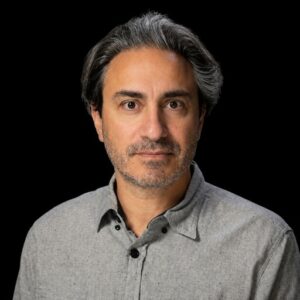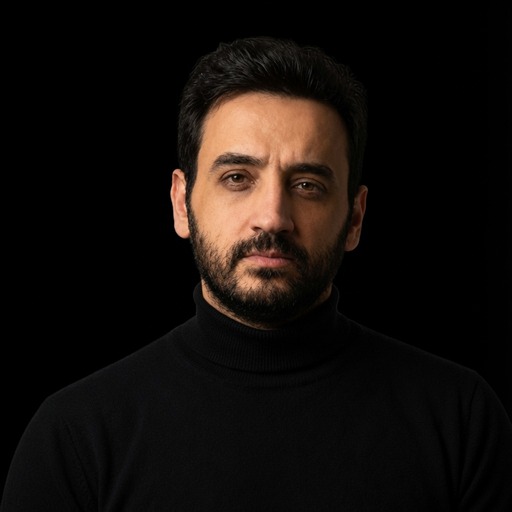
Tawfik Sabouni’s first feature, The Other Side of the Sun, premiered in the Panorama section of the Berlinale, where it won a second prize. The headline writes itself: a Syrian filmmaker, arrested in 2011 for filming the uprising and imprisoned in Saydnaya, returns years later, after the fall of Assad’s regime, to make a film inside the place that held him. But the easy version of that arc, suffering turned into triumph, is not the film Sabouni describes. What he describes is harder, more deliberate, and it turns on a single word: faces.
From Damascus to a Film School in Brussels
The “from prison” half of the title is its own long road. Born in Damascus, Sabouni fell for cinema as a boy, left by his father in a movie theater to watch what turned out to be King Kong, but there was no film school in Syria and no money to study abroad, so he studied something else. When the 2011 uprising began, he picked up a camera to film the demonstrations and felt he was finally doing the thing he was meant to do; he was arrested for it and imprisoned in Saydnaya. After his release he left the country, learned French, and was eventually accepted into the film school INSAS in Brussels, graduating in 2022. He chose directing, he says, only after answering two questions for himself: did he truly have something to say, and could he turn it into films.
A Formal Problem, Not Just a Painful One
The hardest part, Sabouni says, was never access or money or even the memories. It was a question of form. How do you build a story out of events, torture and death, that happened every single day, without turning the unspeakable into spectacle? His answer was to refuse the events and film the people. There are, accordingly, no graphic images and no spectacle in the film, only the weight of a body in a cell, the sound of a door, the tension in a held gesture; his own voice-over opens on the double pull at the heart of it, the fear and the desire to forget set against the fear and the desire to remember. The film begins with the first face he saw the day he was arrested, a weak, tired, unknown face he has never been able to forget, and it builds outward into how the prison made men look alike, how the guards worked to erase one person into the next until mothers sometimes failed to recognize their own sons.
The Whole Film Is an Argument Against Erasure
That structure is the meaning. A system designed to dissolve human beings into an anonymous, interchangeable mass is answered by a film that insists on the irreducible particularity of one face, one gesture, one hand on a shoulder.
Silence can be more dangerous than the crime itself.
The prison’s grim nickname, the other side of the sun, came from its total isolation, a place so cut off that those taken there rarely returned and inmates rarely even glimpsed the sky. To answer that isolation with individuality, Sabouni built the film as a search for faces, the human being held in front of the events rather than buried beneath them. This is what “memory as a form of resistance” means in practice, not a slogan but a method. It is the same conviction that animates Sabouni’s stated touchstone, Rithy Panh’s The Missing Picture, which reconstructs the erased record of the Khmer Rouge from a survivor’s memory and which, Sabouni says, taught him how to turn a personal and painful story into cinema.
His film belongs in that lineage, alongside two others he doesn’t name: Claude Lanzmann’s Shoah, which refuses archival spectacle in favor of testimony returning to the actual sites, and Alain Resnais’s Night and Fog, with its restraint before the camps then and now.
Why Every Choice Follows From the Faces
Once you see that the film is built to defeat erasure, its other decisions stop looking like style and start looking like necessity. Sabouni had originally planned to recreate Saydnaya on a studio set in Belgium, since prisoners were never even allowed to see the building that held them; he had only the images in his mind. When the regime fell and the real prison became reachable, he felt compelled to shoot there instead, because the actual walls hold the actual memory, and he prepared on location for months before an eighteen-day shoot that was very much now or never. He invited four fellow survivors, men he had never met inside, to return and re-inhabit their own daily rituals, the crouched walks, the averted eyes, because a body remembering in the space where it suffered carries what a testimony spoken to a camera would flatten. The men inscribe their memories into the architecture itself, each in a sense performing the others’ experiences, so that five separate incarcerations resolve into one shared account; “we don’t know each other, but we know each other,” he says of them. Sabouni stood on both sides of the camera, sharing the survivors’ grief while his cinematographer served as his eyes at the monitor, and he made sure everyone was free to leave at any time, pausing the shoot for a day or two when the past pressed too hard. He refuses the line between documentary and fiction altogether; for him it is all simply cinema, a film that tells the past through bodies, movements and memories, a philosophy he traces partly to Kim Ki-duk’s Spring, Summer, Fall, Winter… and Spring and its refusal to sort people into the simply good or the simply bad, and partly to Joshua Oppenheimer’s The Act of Killing.
The Limit He Names Himself
What keeps the film from either despair or vengeance is that Sabouni is precise about what it can and cannot do.
Our responsibility as filmmakers is not to solve these problems, but just to tell stories about them.
A film, he insists, does not deliver justice; a grieving mother will not be made whole by watching it. What a film can do is refuse forgetting, and keep the demand for justice alive; this, he has said, is finally less a film about prison than one about love, imagination and resistance. So the work bears witness not only for its five living men but for the roughly 177,000 people who disappeared into Syrian prisons and whose families still search for answers, calling the film a meeting place between the living and the dead. He made it through a process so psychologically punishing he nearly abandoned it more than once, sustained by a producer, Julie Frères, he credits with simply staying beside him, and by the conviction that the world needed to know. When the call came, during the sound mix, that the film would premiere at the Berlinale, he hugged his sound editor and phoned his wife; it was, he says, a moment of pure joy and pride, the kind he believes filmmakers should let themselves stop and feel. His advice to a younger filmmaker is the through-line of everything: stay close to people and their struggles, and keep telling the stories others would rather ignore. That is the real meaning of “from prison to premiere.” The premiere is not the triumph. The triumph is the decision to go back, into the building and into the memory, on purpose, when looking away would have been so much easier, because someone has to hold the door open against forgetting.