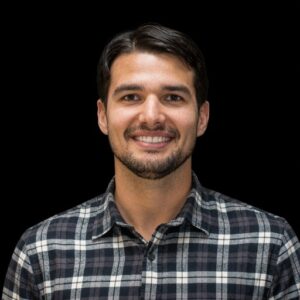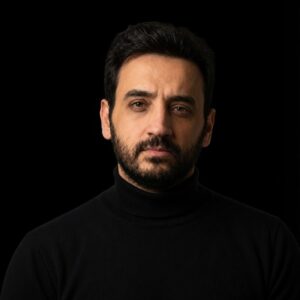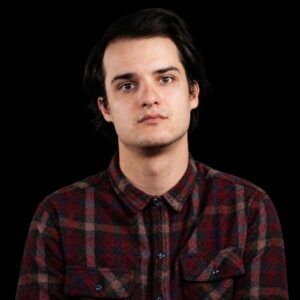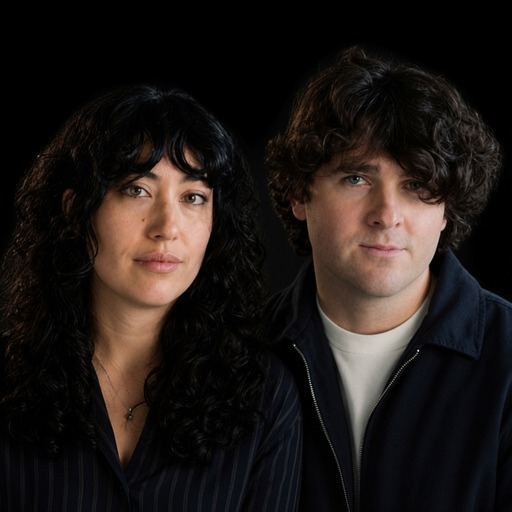
Gabriela Osio Vanden and Jack Weisman are cinematographers, partners, and now the co-directors of Nuisance Bear, which won the U.S. Documentary Grand Jury Prize at the 2026 Sundance Film Festival. The film follows a young polar bear through two connected worlds, the tourist town of Churchill, Manitoba, and the Inuit community of Arviat, Nunavut, asking, in a genuinely shared landscape, who gets to decide who belongs, and who gets labeled a nuisance.
The story existed beyond us, and it was sort of like our responsibility to try to be witness to it.
The Frame as Craft
The film grew from a wordless 2021 short that premiered at TIFF, was picked up by The New Yorker, and was shortlisted for an Oscar. Its breakthrough was not a story idea but a camera position: when they mounted the camera on a moving car, a whole way of seeing the bears unlocked. They cite Darren Aronofsky’s notion that once you find the right position for the camera, the story tells itself. That is an ethic of humility disguised as a technique. The filmmaker is not the author of events but the finder of the vantage from which events, already underway, can reveal themselves. They had first gone to Churchill in 2015 as York University film students, and what struck them was that a place photographed constantly, the single most accessible spot on earth to see polar bears, had never been filmed the way they saw it. The niche was a vantage no one had taken, physically and emotionally. Being inexperienced helped: they knew enough to attempt it but not enough to have decided in advance that it was impossible, and that openness, they say, is a thing you have to fight to keep as you get older. The short carried no dialogue and no music, partly because they couldn’t afford either and partly because COVID stranded them mid-shoot, and the constraint drew them startlingly close to the animal. Weisman, who has a musician’s ear, even rebuilt the missing field audio in post from a film-school sound library, and with designer David Rose the feature grew into roughly 250 tracks; in a film this quiet, half the story is sound.
The Shared Landscape as Subject
The bear is endlessly framed by humans. It is watched, photographed, tagged, trapped, and airlifted, branded a “nuisance,” from the Inuit word avinnaarjuk, for the young bears grown bold around people as the sea ice that should carry them shrinks.
Here the directors’ clearest touchstone is Hayao Miyazaki, specifically the way a film like Princess Mononoke holds humans, animals, and the forest in a single unresolved frame, refusing to name a villain. Nuisance Bear does something similar across its two halves, the midpoint marked literally by the bear’s airlift north, contrasting Churchill’s largely white, tourist-driven economy with Arviat’s Inuit community, who hunt the bears and dispute the outsiders’ extinction narrative. There are almost no talking heads; the only sustained voice is the Inuktitut narration of Mike Tunalaaq Gibbons, an Arviat elder who passed away last year, and otherwise we stay close to the bear’s-eye view, overhearing tourists, guides, and wildlife officers at the edges of the frame. The film declines to demonize or to valorize. It probes rather than concludes. Its quiet radical move is to find a frame that doesn’t simplify, and to grant the bear a grandeur that never once denies its wildness or its danger.
Trust as the Precondition
None of that is possible without trust, which the directors treat as part of the craft rather than a courtesy around it.
Building trust and relationship with the people that you’re filming with has to be a priority just as much as the creative work.
They spent years listening before filming, working with a producer, Michael Code, who belongs to both communities, and they were careful to align themselves with no advocacy campaign and to tell Arviat’s side of a story usually narrated through Churchill. The point is structural: you cannot find an honest vantage on a shared landscape if you are trying to dominate it, whether the subject is an animal, a community, or your own collaborator. The same humility that makes the craft work, the waiting, the listening, the acceptance that the story exists beyond you, is the very thing the film is about. What audiences never see is the cost of that patience: a barely habitable rented house lived in for sixteen months, crew bunking in a laundry room, and the particular agony, unique to wildlife, of learning each evening about the dramatic thing that happened in some other part of town while your camera was pointed at a quiet field.
The Frame Between Two People
The most literal version of that idea is the partnership itself. The two met at York University, fell for each other on that first 2015 trip to Churchill, and learned there to trust each other in conditions that were physically dangerous and artistically high-stakes. On the feature they often split up, one directing in Arviat while the other shot in Churchill, two cameras composing a single film of a shared landscape, with neither as sole author. They didn’t always agree, and they fought it out, sometimes by phone across the tundra, which became its own advice: when the pressure spikes, don’t turn on each other. Their other loves point the same direction, Gus Van Sant for his formal bravery and his trust in non-actors, John Cassavetes less for the films than for the electric, generous spirit of how they were made, the feeling of a crew making something special together. Their own crew, underpaid and all in, gave exactly that. During the festival they got engaged on Main Street in Park City and, on a euphoric impulse, married then and there. It landed at the last Sundance to be held in Park City, and the first since founder Robert Redford’s passing, a melancholy and celebratory air that matched their own overflowing week. A ten-year project and a marriage, both built one shared frame at a time.
The Business of Belonging
That insistence on trust shaped the business, too, which is why this was no simple sale. The short functioned as proof of concept that earned them credibility and a great producing team, including Rise Films’ Teddy Leifer, whose All That Breathe felt like a sister project. When the offers came, they had enough of them to choose alignment over money, and the deciding factor was creative control: A24’s documentary division agreed to final cut, which they considered non-negotiable precisely because they were accountable to Indigenous communities and would not let outsiders who had never been there dictate the edit. The financing was its own labyrinth, the Canadian funding that would have forced them to retain rights they needed to sell, the rules that nearly cost them their American and British producers, the tax treaties they threaded to survive. Their film belongs beside two they don’t name: Victor Kossakovsky’s wordless Gunda, which meets animals on their own terms, and Honeyland, that Sundance portrait of fragile coexistence between a person and the natural world. The deepest truth sits in the title. In a shared landscape, “nuisance” is never a property of the bear. It is a verdict passed by whoever holds the frame, and the film’s whole achievement is to hand that frame to no one, and to the landscape itself.