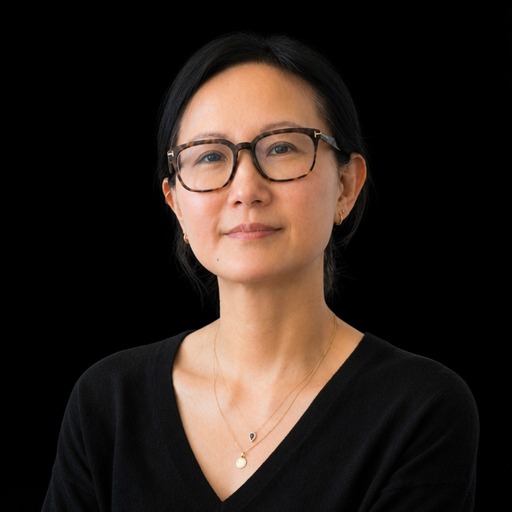
Stephanie Ahn had a real editing career, the kind that lets you make a comfortable living, and she walked away from it to spend the better part of a decade on a story she was terrified to tell. A latchkey kid raised by television, she went to film school wanting to write and direct, worked for other filmmakers and waited tables to keep going, and then fell hard for editing, cutting acclaimed indies like My Old Lady. Her editing career was poised to take off when she reached a crossroads: a comfortable life, or one more swing at the dream. Being a dreamer past a certain age, she says, feels irresponsible, but the alternative was being eaten alive from the inside. Bedford Park, her feature debut, premiered in the U.S. Dramatic Competition at the 2026 Sundance Film Festival, where it won the Special Jury Award for Debut Feature, and was acquired by Sony Pictures Classics for a theatrical release this fall.
I consider myself lucky that it kept nagging at me, and it almost wasn’t my choice. It wouldn’t let go.
The Film and Its Wound
Bedford Park follows Audrey (Moon Choi), a Korean American woman in her thirties carrying the weight of an abusive childhood, who is pulled back to her parents’ New Jersey home after her mother is hurt in a car accident. There she meets Eli (the Korean star Son Suk-ku), the man responsible for the crash, an ex-wrestler raised by adoptive parents and haunted in his own way. Across a cultural gulf and the deep sorrow Koreans call han, two people who carry their pasts in similar ways form an unlikely, tentative connection, and slowly begin to heal each other. Around that connection the film maps a whole cultural geography: Audrey caught between loyalty to her immigrant parents and her American self, Eli a Korean man raised outside Korean culture, the older generation’s expectations pressing on them both. Ahn, a Korean American who never saw her own experience on screen beyond the usual clichés, wrote the film she desperately wanted to see.
The Theme Is Also the Method
Here’s the stance worth drawing out, because the thing the film is about turns out to be the same thing Ahn had to do to make it.
The film is about human connection. When you’re really truly seen by other people, that can help you to see yourself a little more clearly.
That is Audrey’s arc: seen at last by Eli, she begins to see herself. But it is also, precisely, how the film got made. Ahn says the writing was brutal on two fronts, not only because the material was so personal but because she was too close to it to know whether there was a real story there at all. She was too scared to show anyone early drafts. The objectivity she lacked, she could only get by being seen, by the producer who read the script and believed in it, by the lead actors she rehearsed with for years until they could dig deep together, by the co-editor she trusted, in her words, to be meticulous about telling the truth in every moment. You cannot see yourself alone, and you cannot see your own story alone either. It began, fittingly, as journaling, getting everything out so she could go back and find the pieces that made character and plot, and over years of drafts it transformed, from a family drama into a love story, the man rewritten from white American to Korean American, the autobiography fictionalized wherever the better story demanded it. Writing, she says, is editing. It was rejected nearly everywhere, every lab she tried, and survived mostly on her own perseverance. The theme of Bedford Park is the method of Bedford Park.
Why the Scary Road Was the Only Road
This is what makes the scary road the only one that leads anywhere. To be truly seen, you first have to stop hiding, walk straight into the thing you have been avoiding, show the draft, let the actors in, hand the cut to someone you trust. The safe road, the steady editing career, the less personal scripts, the drafts kept in a drawer, is the road of never being seen, and therefore of never quite seeing yourself. Ahn chose the terrifying option because it was the only one pointed toward clarity, and the years of rejection were simply the cost of staying on it. The film grew out of a 2023 short, gathered a producer she had once edited for as an early believer, and only found its footing financially once her cast, major names in Korea, helped unlock Korean backing. Even getting into Sundance she learned at the dentist, from a voicemail she assumed was a note about her cut; when the programmer told her the news, she went silent, unable to take it in. A long road of rejection, she says, only makes the arrival sweeter. Her advice to her younger self says the same thing from another angle: get comfortable with the unknown, throw out the need for security and answers, and you find a strange freedom, and you start to enjoy the process.
What Editing Taught Her
It is no accident that an editor made this particular film. Editing, for Ahn, is the discipline of being seen and clarified. She wanted a co-editor to take the lead precisely because you cannot edit yourself any more than you can see yourself; she needed someone with a matched sensibility who could catch her blind spots and disagree with her honestly. The same instinct shaped the whole production, an unusually long rehearsal, her lead actress cast a full six years before the shoot, meeting for hours over years until the performances were excavated rather than performed; the actors, she stresses, were smart storytellers and full collaborators, not instruments, and the developing was the joy of it. The film’s restraint, its refusal of neat resolutions, its patient pace, all come from that conviction that truth is something you arrive at together, slowly. Even the shoot, in Englewood, New Jersey, opened with a brutally overloaded first day that the crew nonetheless cleared without going over, a baptism that, she says, made the whole team feel briefly invincible.
A Quiet Lineage
Her touchstones are revealing because they look nothing like her film on the surface.
The one she returns to most is Lee Chang-dong’s Secret Sunshine, the masterful Korean drama of a grieving woman undone and remade after a death, which she studies not for its tone but for its architecture, how it builds an emotional structure. She cites Asghar Farhadi’s A Separation at the level of the script, and Jacques Audiard’s Rust and Bone, and, more surprisingly, Michael Mann’s The Insider and Heat, for the poetic isolation his characters move through. Bedford Park belongs beside two films she doesn’t name: Celine Song’s Past Lives, that aching study of Korean American longing and connection, and Charlotte Wells’s Aftersun, an autobiographical debut whose restraint draws its power from the courage to look closely and be seen. Ahn lacked the objectivity to know if her own life made a story. She found out by trusting other people to see it, which is the very thing her film is about. The scary road and the only road were always the same road.