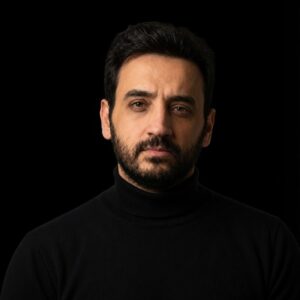
Peter Kerekes opens the conversation with a credo. Documentaries, he says, are like books: there are bestsellers, there are the ones almost nobody reads, and then there is poetry. The best documentary, for him, is always poetry.
Without poetry, our civilization will die.
That’s the bar he sets, and Wishing on a Star, which premiered in the Orizzonti competition at Venice and went on to Toronto, is his attempt to clear it. It’s a film about a Neapolitan astrologer, made by a Slovak director who doesn’t believe in astrology, and it turns out to be about the one thing everyone in it is quietly chasing.
The Man Who Said No for Three Years
Kerekes came to filmmaking sideways, almost in spite of himself. His father was a documentary maker who studied at Prague’s famous FAMU film school in the 1960s alongside the Czech New Wave, then returned to the small city of Košice, where the Soviet occupation boxed him in for the rest of his career, reduced to folklore and nature films because they were the only fields free of propaganda. Peter watched his father come home unhappy, full of absurd stories about censorship, and swore he’d never do this for a living. The Velvet Revolution changed the math; at eighteen, with the regime falling, he figured, why not. He’s only half sure it was the right call. The idiots his father fought, he notes dryly, are still around. Just the names and the parties have changed.
The astrology film he resisted even harder. His Austrian producer Ralph Wieser spent three years pushing him to work with the Italian producer Erica Barbiani on a documentary about Luciana de Leoni d’Asparedo, and for three years Kerekes refused. He makes films about the twentieth century, about women in prison, serious things. He doesn’t even read horoscopes. He went to Italy only to be polite, for a promised dinner, and the moment he met Luciana he was, in his word, trapped.
I still don’t believe in astrology, but I believe in Luciana.
A Body of Work With Only One Thing in Common
Across two decades Kerekes has made films that share almost no subject matter: 66 Seasons, which tells the twentieth-century history of Central Europe through the visitors to a single municipal swimming pool; Cooking History, about military cooks across a century of wars; and 107 Mothers, his Venice-prizewinning docudrama about women raising babies inside an Odessa prison. The only thread he can find running through all of them is a particular sense of humor. Even the gravest of them carries a comic layer, because humor is what closeness produces; when you’re genuinely intimate with someone, you can joke about anything, and that intimacy is the real subject of his work.
What Luciana Actually Does
Here’s the film’s quiet argument, and the stance worth drawing out. Luciana practices what she calls active astrology: after reading a client’s birth chart, she prescribes a trip, a journey on your birthday to a precise faraway place, often somewhere you don’t speak the language, so you can be reborn under a new sky. Kerekes is clear that he thinks it works, and equally clear that the stars have nothing to do with why. She’s a superb psychologist. An hour in her chair is therapy with better charisma; you confess things you meant to keep. Then the pilgrimage does the rest, because every great religion knows the power of the journey, Mecca, Santiago de Compostela, the Ganges, and a person dropped alone into a place where their usual scripts don’t work has no choice but to meet their own desire. The chart is just the permission slip.
That makes the film less about fate than about the technology of meaning itself, and it quietly implicates Kerekes too. He builds the documentary the way Luciana builds a session: through an obvious, loving artifice that delivers a truth plain naturalism couldn’t reach. The astrologer and the documentarian turn out to be the same kind of honest con artist, each constructing a frame in which an ordinary person can finally tell the truth.
Borrowing the Method, Inverting the Misanthropy
The technique behind that artifice comes straight from a filmmaker Kerekes names directly: the Austrian Ulrich Seidl, whose Dog Days won the Grand Jury Prize at Venice in 2001.
Seidl’s method, which shaped a whole generation of Eastern European filmmakers, is to take real people, gather their stories, and have them enact their own lives, a hybrid where amateurs essentially play themselves, lit and framed like fiction. Kerekes uses exactly this. His cinematographer, Martin Kollár, lights Luciana’s studio so it looks glossy and staged, almost unnatural, the opposite of fly-on-the-wall. But where Seidl descends from the nihilist tradition of the writer Thomas Bernhard, a worldview that holds humanity in contempt, Kerekes keeps the toolkit and throws out the cruelty. He uses Seidl’s techniques, he says, but he loves people, and he sweetens the whole thing with the warmth of the daft, big-hearted Italian comedies of the 1970s. It puts Wishing on a Star in the lineage of the humane essay-documentary, near the generosity of Agnès Varda’s The Gleaners and I and the doc-fiction tightrope of Abbas Kiarostami’s Close-Up, where real people reenact their own lives and the staging only deepens the truth.
Five Wishes, Seven Years, Six Aliens
The construction was patient to the point of obsession. Kerekes filmed five days locked in Luciana’s studio, two cameras running through sixteen-odd uninterrupted client sessions, then let her freely send people to Alaska, Russia, Taiwan, Lebanon, and Brazil before selecting five protagonists to follow: a funeral-home owner hunting for a partner, near-identical twins longing for love, an elegant woman finally free of her overbearing late mother, a mother aching for an estranged husband, and a daughter abandoned by her musician father, a story Kerekes admits cut close, since he’s an absent father himself. What unites them is not money but love; that, he found, is what almost everyone wishes for. COVID broke the shoot into pieces, which he calls the biggest blessing the film received, since the gaps gave him and his editor of twenty-five years, Marek Sulík, time to refine between trips. Seven years passed between meeting Luciana and locking the picture. He and Sulík work in short, fierce bursts, five days of cutting, then a reshoot, then five more, quarreling hard because, as Kerekes puts it, if you love something you defend it with every tool you have. The film’s final shape, five chapters of roughly twenty minutes each, emerged only after they had tried what felt like every possible order.
He waves off the romance of small-footprint shooting. A lone filmmaker with a camera is still an intruder, he argues; whether you bring one alien or six aliens, you’re equally foreign to your subject’s world, so you may as well bring the full crew and make it beautiful. What actually earns intimacy isn’t a hidden camera, it’s time and trust, enough of both that people forget the lights and the lavalier and say things they’d never otherwise say. As for the festival run, his strategy is refreshingly unstrategic: show up, meet people, enjoy the conversations, and let the sales agent who found him at a rough-cut lab handle the market. Venice mattered for one reason that has nothing to do with prestige. It was the one place he could get all of his protagonists up on the stage together, which, for a film about ordinary people wishing on the same star, is the only ending that fits.