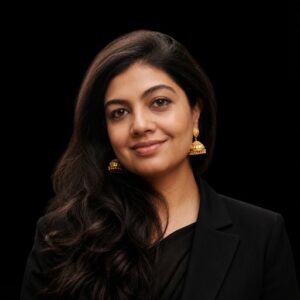
Cara Cusumano has been programming the Tribeca Festival since 2008 and now runs it as festival director, arriving at its 25th anniversary. The episode’s title splits her work into two ideas, discovery and staying ahead. Listen closely and they turn out to be the same instinct pointed in two directions, outward at the audience and inward at the art, and both are a refusal of the algorithm.
Curation Is the Human Answer to “Here’s More of the Same”
Cusumano’s origin story is not film school; it’s a Blockbuster card that functioned as her babysitter. She’d spend hours reading the backs of old slasher tapes, and her most memorable discoveries were things she knew nothing about, grabbed off a shelf or caught late at night on cable, that opened a whole world she didn’t know existed. That instinct started even earlier, at her mom’s Friday-night ritual of a pizza and whatever rental caught her eye, and it never pointed her toward a set. She went from a Barnard film degree to a cinema-studies masters at NYU, and found programming almost by accident, curating shorts for the Brooklyn Film Festival, then the Hamptons, then nearly two decades at Tribeca. She made exactly one short film herself years ago and calls it a blip; what she wanted was never to direct but to watch and to champion. What she built at Tribeca is that video store at scale.
It’s not like we rank them one to 14,000 and the top 100 films get in. It’s really about creating a program that works well together.
She describes programmers as DJs, assembling a wall of films she loves and arranging them so a stranger might grab something they’d never have chosen and be changed by it. Curation, in her telling, is the human counter to the algorithmic logic of “you like X, here’s more X forever.” Its whole purpose is to give you what you didn’t know to ask for, which is also why she’s careful to say that a rejection is about fit, not rank; the festival, she insists, is the filmmaker’s cheerleader, not its adversary.
The Films You Can’t Forget Refuse to Serve You What You Expect
The other half of her work is the same value turned toward the screen. Ask her what makes a film unforgettable and the answer is immediate.
Just stay ahead of your audience. Just give them something that they don’t see coming.
She points to breakouts that keep moving and refuse to let you catch up, and to a kind of restless, escalating storytelling that always asks “what if even more happened.” This is not a different idea from curation; it’s the same one. A film that stays ahead of its audience is doing to the viewer exactly what a good programmer does, declining to hand them only what they already expect. The algorithm gives you more of the same. The surprising film, like the surprising program, gives you the thing you didn’t see coming. Her lodestar here is Orson Welles’s F for Fake, a film that is itself a magic trick about magic tricks, forever one step ahead of the viewer it’s teasing.
Her taste sprawls happily from Agnès Varda to Steven Spielberg to an over-representation of David Fincher she only noticed when she made a list, and her favorite documentaries run from Jiro Dreams of Sushi to the brutal, unforgettable Dear Zachary.
Documentary Is Having the Same Realization
That refusal to serve the expected is, she thinks, remaking documentary in real time. She’s drawn above all to story, the kind of stranger-than-fiction doc where you simply can’t believe what happened, and she’s bullish on the form’s future precisely because everyone now films everything, which means the archive of the present will be astonishingly rich. She points to the rise of body-cam nonfiction like The Perfect Neighbor, a film that could only exist in that form, and to the larger door that’s been kicked open: the sudden permission for a documentary to be a horror movie, a thriller, a rom-com. The guardrails that once boxed the genre in, she says, have simply fallen away.
One Instruction, Wearing Two Hats
Because the goal is to stay ahead of the viewer, her advice to filmmakers is really a single instruction in two guises. The first: tighten the script. The tools of production have never been more accessible, which makes it easy to rush past the writing, and if your movie is going to unfold in one apartment, the script had better be bulletproof; the reason a dinner-party premise like The Invitation works is the writing, not the budget. The second: do not let a festival deadline decide when the film is done. She fields films every year that premiered elsewhere before they were ready, and gently insists the festivals will all come around again next year, so finish the work when the work is finished, especially in documentary. A film shoved out early can’t surprise anyone; it can only disappoint. Both notes serve the same master, the audience that has to be genuinely, continuously earned. And earning them, she stresses, means actually listening to them rather than drinking your own Kool-Aid; a festival, at bottom, is a community event, and the job is to serve that community, not to indulge a programmer’s private taste.
Why the Room Still Matters
Underneath all of it is a conviction Cusumano traces to a specific moment. She moved to New York for college in the late summer of 2001, about a week before the towers fell, and watched Tribeca get born out of that wreckage, Jane Rosenthal and Robert De Niro trying to coax a frightened, shuttered downtown back to life through a film festival. That experience, being on the receiving end of what a festival can do for a community, is the through-line to why she does this. It is also why she prizes discovery so highly: some of her deepest satisfactions come from playing a filmmaker’s very first work, Ryan Coogler’s first short, Damien Chazelle’s first feature well before Whiplash, and watching them go on to shape the culture. Being the youngest of the major festivals, she notes, has kept Tribeca nimble and interdisciplinary, comfortable mixing prestige auteurs with pure fun. The old video-store scarcity taught her the same lesson from another angle: when a thing was hard to get, an appointment to keep, you wanted it more, and you wanted it together. The real product, she argues, was never the film alone; it’s the communal, in-person, unrepeatable experience of discovering something together, in a room, as the first audience in the world to see it. Infinite accessibility, any movie on your phone at any time, quietly devalues exactly that. And she sees the tide turning back: micro-cinemas returning, tech-native younger audiences who grew up on screens now craving the analog thing they never had. Her films belong beside two she doesn’t name: Alfred Hitchcock’s Psycho, the great lesson in staying ahead of your audience, and Giuseppe Tornatore’s Cinema Paradiso, the great lesson in cinema as something you’re handed, communally, by someone who loves it. Discovery and staying ahead finally collapse into one act, keeping wonder alive in a culture engineered to eliminate it. She’s wary of over-diagnosing what keeps her hooked, on the theory that explaining a magic trick kills it, but she’ll admit the movie magic is real: to commit ninety minutes and feel like you’ve lived ten lives. It’s the thing she’s now passing to her own two kids, whom she takes to everything, the way her mother once took her. Her advice to her younger, over-serious self fits the whole philosophy: don’t sweat the small stuff, it’s a dream job, enjoy it more.