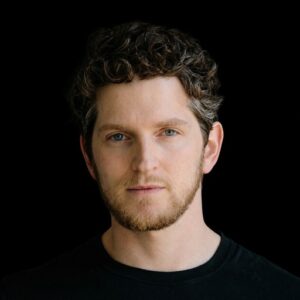
The seed of Happy Holidays was planted at a family breakfast when Scandar Copti was a teenager. He overheard an older female relative instruct her grown son never to let a woman tell him what to do, meaning his wife. To a kid obsessed with math and logic, it landed first as a pure paradox: a woman teaching a man to disregard women. Then the question that would drive his whole career arrived. Why would she say that? The answer he eventually reached, that people internalize their own oppression because it’s too chaotic to live with otherwise, became the engine of the film that won Best Screenplay in the Orizzonti section at Venice and went on to TIFF.
I needed to tell a story on how this normalization of suffering affected me personally.
The Bullseye
Copti, an Oscar nominee for Ajami who now teaches film at NYU Abu Dhabi, never begins with an idea. He begins with something that hits him in the stomach, an injustice he can’t shake, and then he goes looking for help, because he assumes everyone knows the subject better than he does. For Happy Holidays he started with his wife, asking her about the parts of her childhood and her relationship with her own mother that she’d always assumed were too ordinary to matter. Then a social worker connected him to more women with more stories. Only once he’s gathered all of it does he ask what feeling, what philosophical or emotional impact, he’s actually aiming at, what he calls the bullseye. He writes toward that target for specific people he loves, hoping to open their hearts to a slightly different way of seeing. The dialogue he writes mostly to satisfy funders, because, as we’ll see, the people who say those lines will never read them.
The result is a choral story about a middle-class Arab family in Haifa: Fifi, a young woman whose minor car accident driving home from university in Jerusalem threatens to expose the freedom she’s found at school; her brother Rami, panicking because his Jewish girlfriend Shirley intends to keep their baby; and their mother Hanan, papering over the family’s financial collapse while planning a wedding. Lies and unspoken truths spread the damage outward through both Arab and Jewish characters. Two of Copti’s brothers produced it.
A Non-Professional Director
Here’s the method that makes Copti one of the most interesting filmmakers working, and it’s inseparable from the film’s meaning.
I’m a non-professional director that works with non-professional actors.
He casts non-actors chosen for how closely their real personality and occupation match the character. A real doctor plays the doctor, a real nurse the nurse, a real psychiatrist, lawyer, appraiser. Then he spends a full year in role-play workshops, building the characters’ shared histories as lived memory rather than directorial instruction; they celebrate birthdays together, so that the past the film implies actually happened to them. He sent the actress playing Fifi to work in the real school where they’d shoot. He sent the men playing an insurance agent and his father to train with real insurance agents for weeks, partly so the negative thing their characters do wouldn’t be mistaken for who they are.
Crucially, the actors never receive a script and never see the dialogue. So Copti shoots the entire film in chronological order, because the emotion has to be real. If a character is fired and must then go home to tell his wife, Copti engineers a genuine surprise on set, setting the man up to expect a promotion before the boss fires him, so the devastation the next scene needs already lives in his body. He directs two cameras by earpiece through cross-coverage on zoom lenses, uses no movie lights at all so the space stays a real 360-degree room, and skips the boom entirely, cleaning the sound in post. He never says action, cut, or even good, because praise turns a person back into an actor chasing approval. He says we started, and hours later, thank you, and gives a hug. The mantra he carries comes from Frank Zappa, who once warned a young Steve Vai before they walked onstage that it wouldn’t sound professional, but it would be their own music.
Why Chronology Is a Moral Choice
This is the stance worth drawing out, because the process is not a gimmick; it’s an ethic. Copti hates two things, the narcissism of the all-knowing director and the audience’s rush to judge people whose lives they don’t understand, and his method makes both impossible at the level of craft. His actors can’t perform oppression on cue because they don’t know the plot; they can only live it, which means the film’s truth is extracted from real people rather than dictated to them. And there’s a deeper symmetry. The film is about how people are stripped of agency until subjugation feels like their own choice, and Copti’s set does the precise opposite: it hands the people in front of the camera authorship of their own emotional reality. The chronology insists that experience can’t be faked or fast-forwarded, only lived. The form is a quiet rebuke of the very dynamic the story indicts.
He’s candid that this freedom is also a budget strategy. Shooting without lights, without a boom, with locations kept on hold for flexibility, he gets more out of less, and being forced to be creative, he argues, makes the work better than the so-called right way ever would. He edits the 200 hours himself over fifteen months on Avid, rests two months first just to absorb the footage, and treats cutting as elimination rather than the Hitchcockian assembly of pieces. A 45-minute improvised take between Shirley and Rami became two and a half minutes on screen. He keeps a timeline of his deleted darlings and calls it, sweetly, “amazing things.”
The Documentary That Showed Him How
The film Copti names as his touchstone is Alexander Nanau’s 2014 Romanian documentary Toto and His Sisters.
Nanau’s film follows three Roma siblings surviving in a Bucharest apartment while their mother serves a prison sentence for dealing heroin, surrounded by addicted relatives. What seized Copti is what the film refuses to do: across its entire runtime, it never once victimizes or patronizes the children, never tips into poverty porn, and that restraint is exactly why the suffering lands. He pairs it with the Brazilian documentary Bus 174, where you begin certain the hijacker is the villain, then learn his history, then find yourself torn, in a dissonance Copti says he chases in all his own work. It’s the same moral engine that powers Asghar Farhadi’s A Separation, where a small incident cascades into a web in which no one is a villain, and the same humane attention to the overlooked that Sean Baker brings to non-actors in The Florida Project. Copti’s whole project is built against the snap judgment, the thing he calls his biggest pet peeve, when people are passionate about something on limited information. He had to overcome his own version of that to get here, leaving a safe path in engineering, because, as a professor once told him when anyone could cover his work for a week, he wanted to do something only he could do. He found it waiting tables, gathering the stories that became Ajami, and he’s been transforming that adversity into films no one else could make ever since.