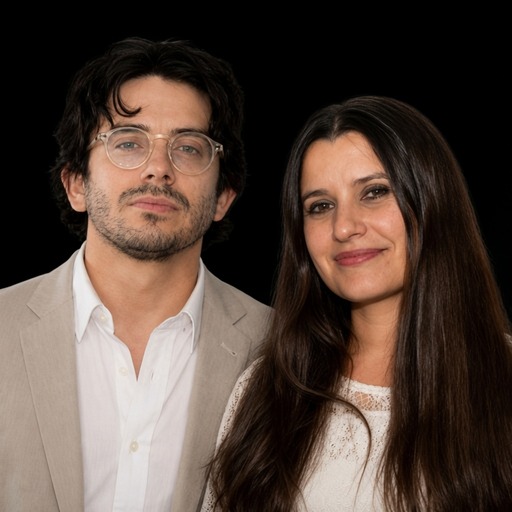
Brian Cassidy and Melanie Shatzky’s A Man Imagined, a 62-minute National Film Board of Canada production, had its world premiere at the International Film Festival Rotterdam, and it announces its method right there in the title.
We make portraiture, but I don’t really think that we tell traditional stories.
Finding Lloyd
The Montreal-based duo, partners who came up as still photographers, knew they wanted to film people surviving on the street, and they knew the genre was thick with well-worn images they wanted no part of. So they spent roughly a year volunteering at a Montreal homeless shelter, handing out coffee and sharing meals, before they met Lloyd. They had planned a multi-character film, partly to hedge against the instability of street life, but the moment they encountered him the plan collapsed into a single subject. Lloyd, 67, has a stone-carved, almost Lincoln-esque face, piercing blue eyes, and a soothing baritone that one of them likens to ASMR, the kind of presence, they felt, that could have stepped out of a daguerreotype or a Russian novel. Crucially, Lloyd approached them. He’d noticed their camera and wanted to be in front of it, so the project began as a genuinely mutual fascination.
A Co-Created Portrait
What followed wasn’t reportage but collaboration. Lloyd turned out to be an artist himself, eager to create, and he took an active role in his own portrayal, playing a version of himself in scenes the three of them designed together, all drawn from his real life but staged as cinematically as possible. He calls the streets his home and never once says the word homeless; he isn’t a man who pities himself, and the filmmakers refuse to pity him either. When they noted that his life sounded hard, he corrected them: it isn’t, really. The film honors that. It has a raw, intense quality without ever tipping into misery porn, because the directors weren’t hunting for a story so much as for a presence, someone, as one of them puts it, who feels inexhaustible in front of the lens, the way a painter keeps returning to the same face under different light, painting it again and again until something inexhaustible in it begins to surface.
Why the Title Is a Confession
Here’s the stance worth drawing out, and it lives in the double meaning of A Man Imagined. Most documentaries about a marginalized or mentally ill subject promise to deliver the truth of that person, the diagnosis, the explanation, the story, which is quietly a kind of violence, fixing a human being as a case the viewer gets to possess. Cassidy and Shatzky do the opposite. They build the entire film around what they cannot know, including Lloyd’s fragmented, unresolved account of something terrible that happened to his parents, a tale he repeated daily for a year that never resolved into anything that would satisfy an investigation.
We do know that his story is real to him. We don’t know if it’s real to you and me.
They refuse to settle it, because settling it would mean choosing their reality over his. The title admits that every portrait is partly a fiction the portraitist invents, that the camera reaches an image of a person and never the person, and the honest response to that limit is not to hide it but to make it the subject. The phrase cuts both ways: the filmmakers are imagining Lloyd as they build him, and Lloyd, with his vast interior life and uncertain memories, is imagining himself into being too, which is, after all, what everyone does. Treating that imaginative life as dignity rather than as a symptom to be diagnosed is the film’s deepest grace. It’s also why the anti-pity stance is more than good manners: pity requires believing you know what someone lacks, and Lloyd, proud of how he navigates the streets, denies you that knowledge entirely.
A Photographer’s Cinema
The form follows directly from the photography both directors came up in.
A photograph, as they put it, resolves without too much information, giving you presence instead of explanation, and that’s their whole approach: the visuals and the aura come first. They have long been drawn to the forgotten edges of cities, the dehumanized non-places they explored in an earlier film called Interchange, and they found rich terrain in setting Lloyd’s survival against Montreal’s harshest perimeters, the refineries of the east end where he weaves between trucks and the Chinatown blocks where he sells his finds. Brian shot much of the film two or three inches from Lloyd’s face, a closeness Lloyd experienced as a kind of caretaking, and the duo built the picture less like a narrative than like an album, accumulating vivid, self-contained scenes and then sequencing them for rhythm, leaning on stark dynamic contrasts, blistering summer cutting to brutal winter, clamoring traffic dropping to the sound of a single bee. Their lodestar here is Ulrich Seidl’s Dog Days, the film Melanie credits with first making her believe she could make something herself, a photographic, deeply empathetic, frequently funny portrait of ordinary people that was wrongly accused of cruelty when it really refused sentimentality. Brian brings in Carl Theodor Dreyer, whose The Passion of Joan of Arc and Vampyr taught him how the human face can carry an entire psychology, and both nod to David Lynch’s refusal to hold an audience’s hand. The film belongs in conversation with two works they don’t name: the Maysles brothers’ Grey Gardens, whose subjects perform knowing versions of themselves for an intimate, un-pitying camera, and Pedro Costa’s painterly Fontainhas films like In Vanda’s Room, which dignify society’s most marginal by letting them co-author their own images.
Trusting the Process
The film reached the NFB through a producer the pair had known loosely for years; the board’s process took them from a proposal and pitch deck to a short demo reel, the documentary equivalent of a Hollywood sizzle, before a greenlight, and that early multi-character plan had doubled as insurance against exactly the instability that defines street life. The making had its terrors. They met Lloyd in February 2020, then COVID shut everything down, and when the NFB finally greenlit the film they couldn’t locate him for a month, since he lives genuinely off the grid, with no phone or email. They walked downtown Montreal for hours with his photograph like people searching for a missing person, until one day he simply called them in that unmistakable baritone, asking what they were doing and when they would go, and once he settled into a halfway house he became remarkably reliable, ready at the door at the agreed hour. They shot only around 45 to 50 days spread across two and a half years, an hour or two at a time, decisive rather than amassing endless footage, with shooting and editing running in parallel so each discovery could open the next. Lloyd has since watched the finished film privately, away from crowds, and loved it, lingering, the directors say, on the close-ups of his own eyes, which he has always known are beautiful. Their advice to younger filmmakers is the through-line of the whole conversation: don’t wait for the money or the perfect conditions, be your own momentum, learn to run the camera and cut the footage yourself if you have to, and just begin.