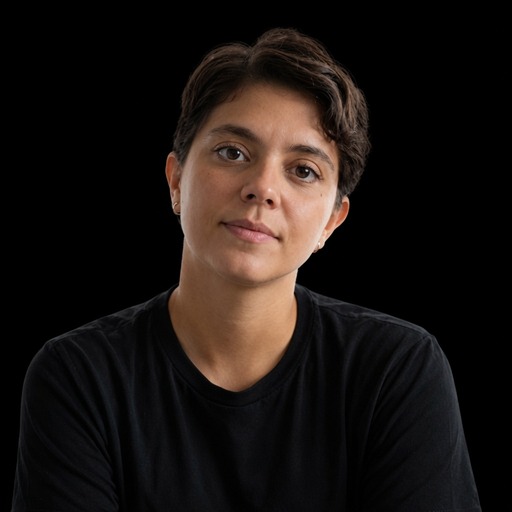
Nayibe Tavares-Abel spent eight years on Colossal, her first feature, which world premiered in the Berlinale’s Forum, the section reserved for films that are experimental in form or want to engage an audience politically. Hers does both, and it found its real shape only when history started happening in front of her camera.
It stopped being a purely historical film and it became something from the present.
A Family Tree as a Map of a Country
The film is an autobiographical reckoning with the Dominican Republic’s buried political history, told across three eras and through Tavares-Abel’s own bloodline. In the 1960s, after the fall of the Trujillo dictatorship, the country’s brief democratic opening collapsed into a coup, a civil war, and a US military intervention, and her great-uncle Amin, an activist against the regime that followed, was murdered. In 1990, her paternal grandfather, the respected lawyer Froilán Tavares, was named head of the Central Electoral Board and then accused of abetting the contested victory of Joaquín Balaguer, a successor to Trujillo, a scandal the film suggests helped break his health. And in 2020, Tavares-Abel herself served as an election observer. To bind these threads, she and her production designer built an enormous collage in the shape of a tree: the roots her family, the branches her research, the trunk the national history, with the director physically adding herself to it on screen, as if she might vanish under the weight of it all.
When the Present Arrived
Here’s the stance worth drawing out, because the title and the method are the same argument. Tavares-Abel had assembled a historical case, but the film became itself when the 2020 election was sabotaged in front of her, voting machines tampered with, and the country poured into the streets in protest. She remembers the dissonance of the moment, knowing it was terrible for democracy and galvanizing for the film, because it stopped being history and started being now. That live footage is not a lucky third act; it is the thesis enacted. A regime survives by controlling the past, by letting people revere Balaguer as a founding father because they never learned what he did. The counter to a controlled past is not a better history lesson, which the powerful can always dispute, but an undeniable present caught on camera that retroactively makes the buried history legible. The protests of 2020 are proof that the patterns of the 1960s and the 1990s never ended. She built the film to work on two scales at once, specific enough to make Dominicans confront a history many were never taught, and universal enough that a viewer anywhere with a relative scarred by war or a sense that their vote changes nothing can feel the same ache.
Standing Inside the Story
This is why putting herself on camera was the first decision she made, back in 2017. Colossal is not journalism about the Dominican Republic; it is a descendant standing inside the wreckage and refusing the inherited instruction to keep quiet.
As filmmakers, we’re not just here to provide entertainment. We have power.
The transgenerational fear she describes, a grandfather murmuring to be careful what you say and to whom, is precisely how political violence reproduces itself without firing a shot, and she frames the documentary as a way to break that silence. She is careful and humane about it, noting that the violence has changed form rather than vanished: a friend who leads a feminist movement is attacked now not with bullets but with smear campaigns and leaked private images, designed to discredit rather than to kill. The film also resists tidy verdicts, including about her own grandfather, leaving the truth, as one Berlinale writer put it, somewhere between family recollection and family silence. She is equally clear about the ethics of pointing a camera at anyone, and especially across class: a filmmaker from privilege, she says, cannot behave like a vampire and steal a story, but has to build a real relationship and represent people as they are rather than as a projection.
How She Got Here
Tavares-Abel came to film by a winding path. Her first memory of a camera is her grandmother’s camcorder, which recorded every birthday and trip, leaving some ninety tapes the director still owns and has barely begun to watch. She studied political science and French, joined a student theater troupe in France simply to practice the language, fell for performance, and only at twenty-eight enrolled in the filmmaking conservatory at Altos de Chavon in her native Santo Domingo. Her hybrid short Carmencita, built from her great-grandmother’s 1920 diary and a silent sixteen-millimeter film-within-the-film, was the dry run for using her own family archive as cinema, and she is candid that simply having such an archive, the photographs and diaries and home videos, is a privilege not every family is granted.
A Comparison and Two Cousins
When Marcus reaches for a point of comparison, he lands on Madeleine Gavin’s Beyond Utopia.
That film’s image of a North Korean grandmother who praises the regime even after escaping it captures the Stockholm-syndrome puzzle at the center of Tavares-Abel’s work too, why people revere the leader who oppressed them. Marcus also invokes the Romanian vérité landmark Collective as a model of present-tense documentary. Colossal belongs in conversation with two films neither of them names: Patricio Guzmán’s Nostalgia for the Light, the great Latin American essay on memory and a nation’s political wounds, and Sarah Polley’s Stories We Tell, in which a director excavates her own family’s buried truth on camera and lets the form itself become the inquiry.
Holding the Cards
Eight years was not all shooting. After capturing the 2020 upheaval she stopped for nine months in 2021, partly from industry work and partly to understand how the present connected to the 1960s and the 1990s. She and her editor thought the film was finished in 2023, then began screening it privately for colleagues, watched where people lost the thread or lost interest, and kept cutting for two more years. It is the documentary maker’s particular humility, learning to make not the film you imagined but the one the material actually wants, and she is frank that she rarely ends up with the structure she first pictured, and that the film is usually better for it.
Tavares-Abel is refreshingly deliberate about the business end. The footage in the film moves across formats to match its eras, sixteen-millimeter black and white reconstructed for the 1960s, VHS from a French co-producer for the 1990s, handheld digital for the present. And on distribution, she and her producer made a pointed choice: no sales agent. They reached Berlin on their own, the film is intensely personal, and they wanted control over where their eight-year project goes, so they intend to court festivals and buyers directly and build those relationships themselves. It is a real risk, taken with eyes open, and it fits the film’s whole spirit. Her hope was for the premiere to resonate beyond the Caribbean, especially as Germany headed into an election with its own far right rising, the point being that democracy is fragile and unfinished everywhere, even in the countries that consider themselves its safest homes, a work in progress filmed mid-sentence. Her advice to her younger self is the same instinct that carried the film: make the films that you want to watch.