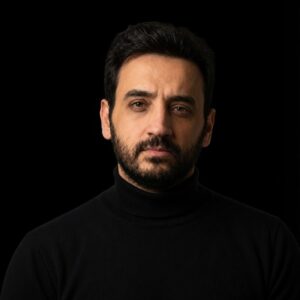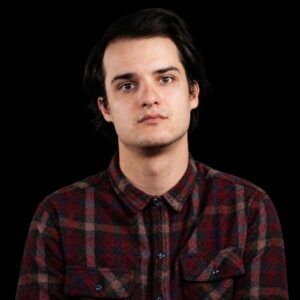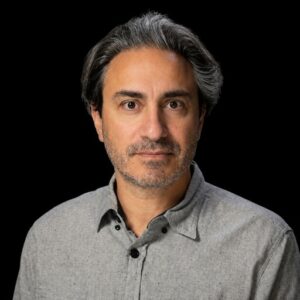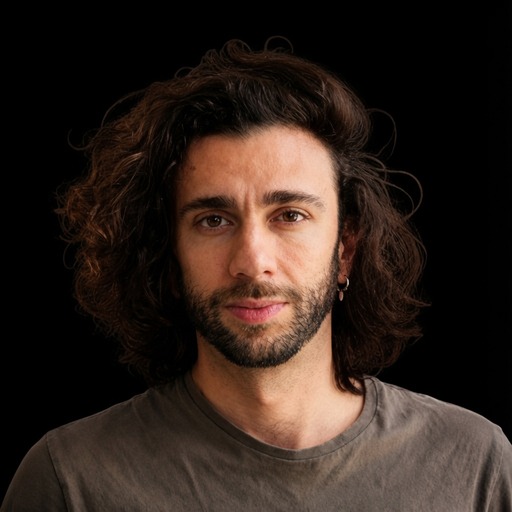
Gianluca Matarrese brought GEN_ to the World Cinema Documentary Competition at the 2025 Sundance Film Festival, his first time at a festival he’d dreamed of since the 1980s, and the film distills a philosophy he’s been chasing across nine features.
Intimacy is actually political.
One Office, Two Wishes
GEN_ is a cinema-vérité portrait of Dr. Maurizio Bini, a soft-spoken endocrinologist nearing retirement at Milan’s Niguarda public hospital, the only public hospital in Italy authorized to provide both fertility treatments and gender-affirming care, all free of charge. In the same consultation room, Bini helps people conceive children and helps people transition, and the film’s title gestures at the prefix shared by the words his work revolves around: genes, genitals, gender, genetics. The project didn’t even start with Matarrese. His friend Donatella Della Ratta, an anthropologist researching a book on the market and politics surrounding bodies, was pointed toward Bini and asked Matarrese to come film while she observed. On the very first day, he found his place in the room, tucked behind a bookshelf, watching like a small bird, present but never voyeuristic, and roughly forty percent of the entire finished film unfolds from that single, patient vantage.
Refusing the Misery
Here’s the stance that makes the film radical, and it’s a refusal. Most documentaries about fertility or transition are built as arcs, the suffering, the obstacles, the resolution, a structure Matarrese finds not just clichéd but quietly dishonest, because it lets the viewer watch from the safe shore of someone whose body has never been a bureaucratic problem.
People are more complex than the labels we want to slap on them.
He throws the arc away and keeps only the consultation, the threshold moment where a person states a desire about their own body to the one figure who can grant or deny it. By staying in that room, he reveals that fertility and transition are secretly the same story: a human being asking the state, through the proxy of a kind doctor, for permission to become who they need to be. That’s why housing both in one film and one office is the master stroke. It quietly collapses the false border between having a baby, sanctioned and traditional, and changing gender, contested and othered, into a single ordinary act of bodily self-determination, and it does so without a word of argument, simply by watching the same doctor extend the same care to both. The bookshelf vantage isn’t shyness, it’s an ethical position: low and to the side, neither the doctor’s authority nor a clinical god’s-eye view, but the height of a person waiting their turn. And the hospital, beset throughout by noisy renovation, becomes the film’s thesis made architecture, a public institution forever half-finished and underfunded, which is precisely where these acts of becoming are forced to happen. Matarrese refuses to look down on his subjects, insisting that the viewer sit at their level rather than gaze, relieved and superior, at someone else’s pain. It’s a deeply Italian act of defiance, too, made in a country whose government campaigns on traditional family values and whose law restricts who may even seek this help.
This is a quest Matarrese has been on since his very first film, a documentary about the bankruptcy of his own family’s business, followed by a portrait of an ex-lover withdrawing from life. He keeps returning to private, intimate spaces precisely because he believes the political lives there, in the small rooms where ordinary people negotiate with the systems that govern their bodies and futures. What grips him in Bini’s office isn’t anyone’s pain but the quality of the exchanges, the care and empathy moving in both directions, the privileged words patients let him witness at the single most charged moment of their lives.
What He Learned From Wiseman, and From Varda
Matarrese’s form descends directly from Frederick Wiseman, whose decades of patient, narration-free portraits of public institutions, places like the welfare office and the hospital, taught him how to watch a system and its people without explaining them to death. He studied those films in school, later met Wiseman in Paris, and sat in on two of his on-stage seminars. He even shot a longer, four-hour cut threading the lives of the psychologist and urologist in Bini’s department, a properly Wisemanian film, before realizing that what he truly wanted was just the exchanges, the precious, privileged words passing between doctor and patient.
The other half of his ethic comes from Agnès Varda, whose Faces Places embodies the rule he lives by: you have to love what you’re filming. Varda’s road trip making portraits of ordinary people radiates exactly the affection Matarrese brings to a clinic, and he extends it even to subjects he might find egocentric or wrong-headed, drawing his only line at cruelty and intolerance. The film belongs in conversation with two observational masters he doesn’t name, Nicolas Philibert, whose On the Adamant finds grace in the daily exchanges of a psychiatric day center, and Raymond Depardon, whose patient institutional documentaries watch French clinics and courtrooms with the same unhurried care.
Documentary Doesn’t Exist
Matarrese’s deepest conviction is that the line he’s working is imaginary. A trained theater actor, a veteran of trashy reality TV, and a maker of docufiction like his earlier The Zola Experience, he insists that documentary doesn’t exist, that it’s all storytelling and packaging, an artistic object rather than a window onto truth. He doesn’t separate life from art at all, films constantly, thinks in stories constantly, and keeps a therapist precisely so his neuroses stay outside the work, because a film that becomes the director’s therapy is just a private, egocentric film rather than a universal one. He embraces the happy accidents the work hands him, a biologist in the department who becomes pregnant during the shoot, the boat and hot-air-balloon murals left over from the ward’s former life as a maternity unit, and calls them miracles, the genuine reward of filming reality. The film’s texture is just as deliberate. His longtime composer, who has known the project from the start and trades demos with him during the edit rather than scoring after the fact, built the soundtrack around an ironic Exotica style borrowed from late-1960s and 1970s Italian comedies, blending synthetic, digital tones with real flutes and violins, a sound that lifts you somewhere far away, mirroring the escapist murals on the walls and undercutting the bureaucratic grind with a sly, tender wit. He’s relentlessly prolific by design, one film writing while another shoots while a third edits, flying off to start a new feature in southern Italy the day after this conversation, building a loyal family of collaborators who trust him before the money arrives. Three consecutive years at Venice gave him a sense of arrival, but he’s clear that what looks like luck is really years of holding a story in his head and refusing to let go, and that Sundance, possibly in its final edition in Park City, remains for him what it always was: a place that still loves cinema for its own sake, the launchpad of the independent heroes he grew up idolizing, from Tarantino and Soderbergh to Sean Baker, whose lean, low-budget triumphs convinced him that a singular film needs conviction far more than it needs money.