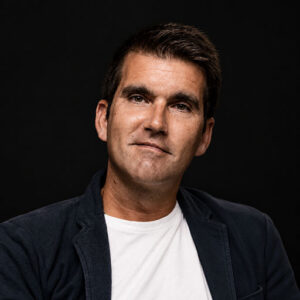
Vincent Grashaw spent his entire twenties trying to make one movie. He wrote it the year after high school, at nineteen, submitted it to Project Greenlight, and watched it crack the top thirty. Then the financing came together and fell apart, came together and fell apart. The lesson he took from that decade of daggers is the one that titles this episode and runs through everything he’s made since: nobody is coming to hand you a career, so you direct your own destiny or you don’t get one. Bang Bang, his boxing drama starring Tim Blake Nelson, premiered at Tribeca, went to Locarno’s Piazza Grande, and screened at Deauville. It’s also, read a certain way, a film about what happens when a man tries to direct someone else’s.
The Bellflower Lesson
The proof of concept for Grashaw’s whole philosophy was Bellflower, the 2011 cult object he produced and acted in for director Evan Glodell. A group of about eleven friends made it for what ended up being twenty thousand dollars they never actually had at any one time, shooting in pieces over two years, building their own flamethrowers. They held a test screening in LA and two-thirds of the room told them it was a chaotic mess. A friend badgered them into submitting to Sundance anyway, on the last day, with a bare link and no press kit. It got in, sold to Adam Yauch’s Oscilloscope, and earned two Independent Spirit nominations; one of the executives who circled it, David Fenkel, would go on to co-found A24.
Control your own destiny.
That’s the gospel Grashaw preaches to any filmmaker who’ll listen, and he means it literally: the single hardest and most important thing is refusing to wait for permission. He’s candid that no production company has ever said yes to one of his pitches. Every film he’s made has been financed by a private investor, which is why his actual advice, delivered with a grin, is to find a rich person, and why his real advice is to gather the friends who need it as badly as you do and take the swing yourselves.
The Wrestler in the Corner
Grashaw grew up around boxing. He trained, though never professionally, and his grandfather was a Golden Gloves fighter in 1940s Michigan whose newspaper clippings he still keeps. So when a producer brought him Will Janowitz’s script, the sport hit close to home, but he’s emphatic that Bang Bang isn’t really a boxing movie. It’s an anti-boxing movie. The film he reaches for as a comparison is Darren Aronofsky’s The Wrestler.
Aronofsky’s 2008 film follows Randy “The Ram” Robinson, an aging wrestler clinging to his 1980s peak, body failing, daughter estranged, the ring the only place he feels like himself. Bang Bang transposes that to Bernard “Bang Bang” Rozyski, a washed-up Detroit prizefighter played by Tim Blake Nelson, drinking himself toward the bottom in a crumbling blue-collar house while the rival who eclipsed him runs for mayor. Grashaw is blunt about why the genre attracts him and why it’s tragic: the thing a fighter is left with after the sport is almost never triumph.
What you’re left with in a sport like boxing is actually tragic more than it is ever positive.
You give up your brain, your health, sometimes your life, for the entertainment, he says, and most fighters come out damaged and unrecoverable. Bang Bang is less interested in the climb than in the wreckage at the bottom, which is also where The Wrestler lives.
Casting on Instinct
The lead nearly went elsewhere. Janowitz’s script had a six-year life before Grashaw, cycling through earlier directors; one version had Danny Glover attached as Bang Bang. When Grashaw came aboard, the team first courted Andrew Dice Clay, who responded to the material, but his schedule wanted a months-long delay and Grashaw won’t gamble a low-budget film’s window on a maybe, so they moved on to Tim Blake Nelson. Andrew Liner auditioned his way in over several reads, including one on Zoom with Nelson. Grashaw sealed it the way he does most things, on instinct, texting the kid to see how he’d react: are you ready to do this. The reply, an enthusiastic yes, was all he needed. To get both leads ring-credible, he leaned on real boxing minds, with the trainer and broadcaster Teddy Atlas serving as a technical advisor.
Control Mistaken for Love
Here’s the stance the film earns, and it’s why the episode’s title cuts deeper than a pep talk. When Bernard’s estranged grandson Justin, played by Andrew Liner, lands on his doorstep, Bernard sees raw physical gifts and decides to train him. Grashaw is careful to say it lights a fire under a self-destructing man and gives him purpose, then curdles into something selfish, a paranoid old fighter putting a kid in real danger for his own reasons. That’s the dark mirror. Directing your own destiny is heroic. Directing someone else’s, even a grandson you’ve convinced yourself you’re saving, is predation wearing the mask of mentorship. The film is a study of a man who can no longer tell the difference between control and love, and the boxing is his alibi, a socially sanctioned arena to inflict damage he could never otherwise name.
It puts Bang Bang closer to Whiplash than to Rocky, a story about a mentor who mistakes endangerment for devotion, and it shares with Million Dollar Baby the understanding that the gym is where surrogate families form and then break. Grashaw resists calling it a redemption story at all. His own test, he says, is to imagine where a character is the day after the movie ends; for Bernard, he pictures him in a grocery store getting beaten by his Ukrainian ex while he just tries to buy a couple of steaks. Closure, in this man’s world, arrives like a truck.
Faces in Wide Angle, Dirt in the Image
The form serves the claustrophobia. Grashaw shot the entire film on wide lenses, nothing longer than a 35, mostly 12s through 25s, framed at 1.85 and cropped to a boxy 2.0, so the camera sits right in Bernard’s warping, off-kilter face. He wanted the audience trapped in there with him, not observing from the safe distance a longer lens provides. The brutal centerpiece fight with Tim Blake Nelson he had only six hours to capture as the Kentucky sun went down, with no budget to light the mansion interior back to daylight, and he deliberately let it run past comfort, until two men go from bravado to gassed-out and pathetic.
Then there’s the part of the craft nobody discusses, which Grashaw treats as a headline: color. He flew to Berlin and spent thirteen days with his colorist, Marina Stark, far beyond the six or seven days an indie usually gets, having Kodak run stills through a film scan and matching the grain back in, building separate masters for theatrical and home streaming because the information is different. He wanted Bang Bang to feel like a worn film print from Detroit, neo-noir and dirtied-up, not the too-clean digital default. It’s of a piece with the rest of his method: the studios, he argues, have abandoned the viewer’s experience to return-on-investment thinking, and the way back is the thing he’s been doing since he was nineteen, gathering the right people and taking the swing, because the only career a filmmaker can count on is the one he refuses to wait for.