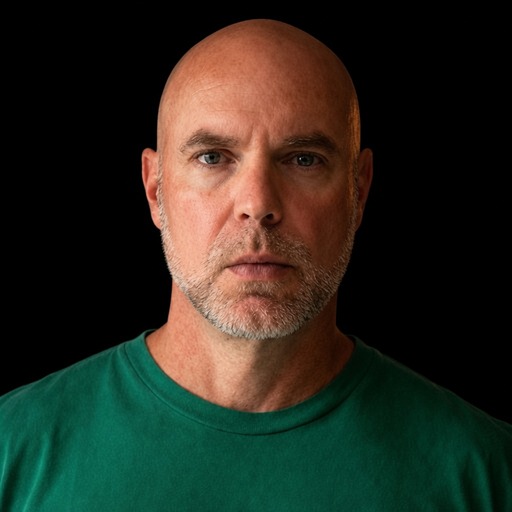
Nathan Tape spent roughly fifteen years as a gaffer and electrician, lighting other people’s movies, before he directed his own. He doesn’t treat those years as a detour. He treats them as the part of his education that film school couldn’t provide, the place where theory met the brutal practicality of a set that’s behind schedule and over budget with the light going. Off Ramp, his feature debut, is a road movie about two Juggalos driving across America’s underbelly to the Gathering of the Juggalos, the one place they feel they belong. It world-premiered at Poland’s Splat!FilmFest, where it won Best Film, and it’s the rare debut whose subject, whose maker, and whose release strategy are all telling the same story.
The Rest of Film School
Tape and Marcus met in New Orleans in 2009, two below-the-line crew members who both secretly wanted to direct. Tape’s account of what a big set teaches is the heart of the episode. You watch the directors, the good and the bad. You absorb how a department head manages people and crises. And above all you internalize one lesson.
I think filmmaking is solving problems.
On a large production, he points out, you rarely get to say no. The only question is how: how do we do it, how do we compromise, how do we solve this before we lose the day. He learned to move fast, to make a decision and live with it rather than agonize, and to recognize how little equipment the best images often require, that some of the most beautiful shots on a thirty-truck show came from one or two pieces of gear run-and-gun. He also learned, lighting for cinematographers like Matthew Libatique, that craft is something you steal by watching closely. The work ethic, the speed, the rigging know-how, none of it looks impressive on a director’s resume, but it’s exactly what carried him through Off Ramp‘s disasters.
And there were disasters. They shot eighteen days in January 2022, then discovered three memory cards were lost, a day and a half of footage gone, including a big fireworks sequence and a complicated single take entering the villain Scarecrow’s house. They recovered eleven of thirteen takes off a damaged drive and had an effects friend repair the artifacting on the only usable one. The loss forced reshoots that March, which, Tape says, quietly made the film better; the break let him and co-writer Tim Cairo re-edit, rethink, and fix a pivotal traffic-stop scene that hadn’t been working. Another night nearly collapsed when the actor playing Scarecrow developed a blood clot in his neck on the first of two evenings set aside for the film’s big ceremony scene; rather than lose the night, Tape pulled on the costume himself to grab inserts and practical effects, then got the actor back the next day to finish it, and the seam is invisible. The problem-solving reflex, learned on other people’s sets, became the thing that saved his own.
The Wound of Rejection
The off-ramp wasn’t a straight road. Tape’s graduate-school short film, which he was sure would light the world on fire, got rejected everywhere, and the sting drove him deeper into gaffing for years, partly because steady work hurt less than submitting his own art for refusal.
The only thing I ever want to do is make movies and watch them.
That’s the engine that kept the dream idling under the day job. He’s clear-eyed now that some filmmakers arrive fully formed at twenty-six, the Tarantinos and Paul Thomas Andersons, and some, like him, need a longer road, and that he’s a better director in his forties than he’d have been in his twenties because he’s more thoughtful about what he’s actually trying to say. The resilience the rejection forced on him is, in retrospect, the same resilience the work demands every single day.
The Wild at Heart of It
Ask Tape for the film closest to Off Ramp and he doesn’t hesitate: David Lynch’s Wild at Heart.
Lynch’s 1990 Palme d’Or winner sends Nicolas Cage and Laura Dern on a violent, tender, deeply strange road trip through the American South, lurching from comedy to dread to romance without ever announcing which one you’re in. That tonal refusal to sit still is exactly what Tape and Cairo wanted: a film that makes you laugh, cry, cheer, and cringe, sometimes in the same scene. They had two working nicknames for the script, “Juggalo Sideways” and “the Terrence Malick Juggalo movie,” with Badlands as a road-trip lodestar. Off Ramp lives in that lineage of American outsider cinema, somewhere near the abrasive tenderness of Harmony Korine’s Gummo and the found-family drift of Andrea Arnold’s American Honey, where the violence and the sweetness are inseparable.
Here’s the stance the film earns. Off Ramp‘s subject and its predicament are the same thing. Juggalos built a chosen family precisely because the mainstream mocked and rejected them, and the film can only live the way its subjects do, adopted by a devoted few rather than blessed by the gatekeepers. When a Blumhouse contact told Tape they loved it but couldn’t do anything with it, that it needed to become a cult film, that wasn’t a rejection to soften. It was the point. A gaffer the industry uses but rarely promotes made a movie about outsiders the culture uses but rarely embraces, and he’s releasing it the only honest way such a film can go: fan to fan.
A Festival Home, Then a DIY Release
The festival run is where the belonging theme stops being metaphor. After eight grinding months of rejections, the first yes came from the New Orleans Film Festival, his hometown fest, and Tape says he dropped to the floor crying. Then his sales company, the Coven, landed him the world premiere at Splat!FilmFest in Warsaw, part of the prestigious Méliès network of European genre festivals, where Off Ramp became the first world premiere in the festival’s history and won Best Film by audience vote. More awards followed at Boston Underground and Chattanooga, and the pattern Tape kept noticing was that genre festivals are communities, full of young people hungry to gather around the same weird movies, the exact thing his film is about.
The release extends the logic. Off Ramp went out through Freestyle Digital Media on September 6, paired with a multi-city theatrical tour built around Q&As and event screenings, the model small films like Hundreds of Beavers have used to turn a release into a happening. Tape leans hard on the Juggalo audience’s love of physical media and on grassroots, fan-to-fan word of mouth, the only marketing a niche film can really afford. He’s lived through the horror stories, the collapse of the aggregator Distribber that left filmmakers’ movies locked away and unpaid, and he’s watching the next wave of direct-to-audience platforms with real interest, because the open question that animates him isn’t only how films are distributed now but how they should be, how you build the free-market path from a movie to the few thousand people who will love it like their own. For a director who spent fifteen years carrying boxes so he could one day tell his own story, that’s not a compromise. It’s the whole point: you don’t wait to be let in, you build the room.