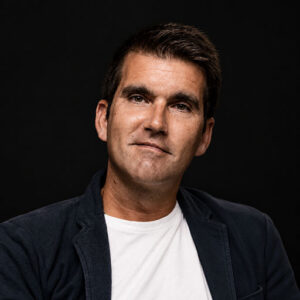
Elliott Lester took on The Thicket with two non-negotiable conditions. An agent ran him through a roster of projects, he landed on this adaptation of Joe R. Lansdale’s frontier novel, and he came back with terms: the villain had to be a woman, and he had to meet Peter Dinklage before he’d commit. Both were granted, and within days he was walking across the Brooklyn Bridge to sit down with the actor who’d been trying to make this film for eleven years. That’s the whole Lester method in miniature. Be direct, decide what the movie is, and then go find out if the people you need are making the same movie you are.
Casting Is King
Lester says it plainly, and it’s the spine of everything he does.
Casting is king for me as a director.
He’s earned the right to the cliché. He directed Arnold Schwarzenegger against type in the somber drama Aftermath, gave David Oyelowo a one-man showcase in HBO’s Nightingale, and surrounded Jason Statham with Mark Rylance, Aidan Gillen, and Paddy Considine in Blitz. His test for whether he’s found the right actor isn’t the audition; it’s curiosity. The ones who phone it in, he can spot. The ones he wants are the ones who call him constantly, question after question, who become as obsessive about the film as he is. Dinklage, he says, is that kind of collaborator, a producer as serious as he is an actor, a man who once he’s in won’t take his foot off the film until it’s made.
The stance worth drawing out is what The Thicket‘s cast actually is, underneath the names. It isn’t just A-list talent; it’s a deliberate collision of wildly different skill levels forced to share a frame. Dinklage, the eleven-year veteran and producer. Juliette Lewis, a feral vessel who vanishes so completely that, in Lester’s words, Juliette disappears and Cut Throat Bill shows up. James Hetfield of Metallica, who’d barely acted. And Levon Hawke, the son of Ethan Hawke and Uma Thurman, six months into his career. On paper that mix should wobble. It holds because Lester’s philosophy is precisely what lets it hold: cast people who take ownership, then get out of their way. He’ll also bet on an actor the town has bruised. He cast Leslie Grace as Jimmie Sue having watched her get blamed when a big film of hers was shelved, reasoning that whatever she’d done to land that part in the first place proved an ability nobody could take back, and that an actor treated that roughly will give a hundred percent at everything.
How You Get a Rock Star into a Western
The Hetfield casting is the clearest demonstration. Lester woke from a dream convinced the film needed James Hetfield, told Dinklage, and Dinklage agreed on the spot. The usual channels went nowhere, so they routed through Sacha Gervasi, who’d directed the metal documentary Anvil, and two weeks later they were on a Zoom with Hetfield, who said he was at a stage in his life where he wanted to take risks. He showed up nervous and honest: I’m not an actor, just point me in the right direction and I’ll get it. For Lester that was the whole audition. He plays Simon Deasy, brother to Macon Blair’s Malachi, and that unmistakable voice does half the work of placing him on the frontier.
This is where Walter Hill hangs over the conversation. Hill, who became a mentor after Lester met him through Hill’s wife, the agent Hildy Gottlieb, made the film Marcus reaches for as a comparison: Last Man Standing.
Hill’s 1996 picture drops a gunslinger-for-hire into a lawless town and lets the violence build with a lean, propulsive flow, the same momentum Marcus felt in The Thicket. Hill, who came to the premiere, is the model Lester keeps in view: a director who steers rather than lectures.
What you need is an absence of fear, not fearlessness.
That distinction is the gift Lester hands his cast. He isn’t fearless on a set where anything can shut the production down. He’s simply removed fear from the room, which is exactly what lets a non-actor like Hetfield and a malleable newcomer like Hawke stand exposed beside Dinklage and Lewis without flinching.
The Villain Had to Be a Woman
Lester’s first condition wasn’t a diversity note; it was a story instinct, and it’s the smartest thing in the film. The Thicket follows young Jack, played by Hawke, who hires Dinklage’s bounty hunter Reginald Jones to recover his sister Lula, played by Esmé Creed-Miles, after she’s taken by the killer Cut Throat Bill. By making Bill a woman nobody in the world quite registers as one, Lester locates the film’s strangeness. A Lansdale frontier is a place where the categories you bring to a Western, who’s dangerous, who needs saving, who holds power, get scrambled. The structure is the bones of True Grit, a child hiring a hard man to chase a murderer across hostile country, but the casting of Lewis as the apex predator makes the whole world feel correctly unsafe. Lewis found the character voice-first, sent Lester clips of it, and shaped her own wardrobe and props, and he let her, because over-noting a great actor only breaks the spell. His direction with her was a handful of words, faster, slower, deeper, the rest left to the vessel. For a film working in Lansdale’s grim register, the closest cousins are his other adaptation, Cold in July, and the brutal rescue-party dread of Bone Tomahawk.
Forty Below, and the Hang
The shoot was in Calgary, the same brutal landscape used for The Revenant, at minus thirty-five degrees with a wind chill near minus seventy-five, in period clothing, on a production that shut down eleven times for weather and, on day one, a guild bond dispute that nearly sent the actors home. Lester’s answer to that misery was deliberate: if you’re suffering together, you’d better enjoy each other. His wife cooked moose and elk the local crew brought in, and the cast gathered nightly over wine to talk about the day. He’s still in contact with all of them, which he says isn’t always how it goes. Visually he’s moved past stealing from other films toward photographs and paintings, blocking scenes by acting out every part himself for his cinematographer Guillermo Garza until they had a full storyboard bible, then lighting interiors with real period tungsten bulbs and firelight and letting the rest fall to black.
Then comes the part of the job Lester refuses to undersell: getting The Thicket seen. Tubi backed it on a philosophy he admires, no audience too small, and after the edit handed him only three tiny notes before blessing the film. Crucially, Tubi committed to a theatrical run, a rarity for a streamer, with Samuel Goldwyn giving it an art-house specialty release across the top markets, the Lumiere in LA, the Angelika in New York, before the Deauville Film Festival’s 50th anniversary. Lester is clear-eyed that a director rarely controls this part, that distributors decide what a film deserves, and that the goal now, with streaming subscriptions stacking toward three or four hundred dollars a month, is simply to get the work in front of whoever will have it. He casts like the film depends on it, because it does, and then he lets it go where it can.