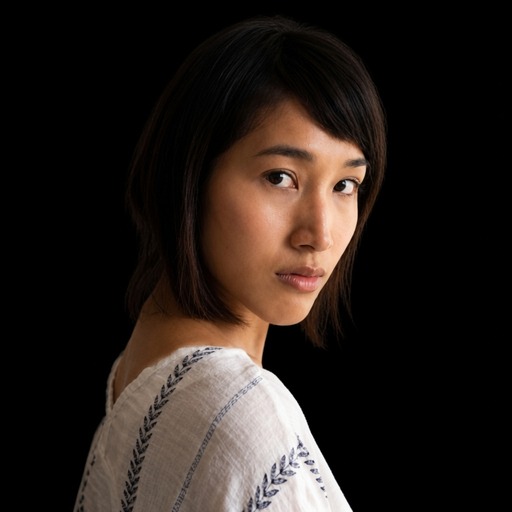
Dương Diệu Linh wanted to be a surgeon. She was good with a scalpel, good at slicing a fish open and getting the guts out, and only chemistry stood in the way of medical school in Vietnam. That early appetite, the urge to open a thing up and see how it works underneath, never left her. It just changed organs. Don’t Cry, Butterfly, her debut feature, took the Grand Prize at Venice International Film Critics’ Week and the section’s Most Innovative Film award, and it works by opening a woman up to show you the feeling she’s been told to keep inside.
The premise is a domestic humiliation. Tâm, a middle-aged wedding-venue worker in Hanoi played by Tú Oanh, learns on live television that her husband is having an affair. Rather than confront him, she hires a spellmaster to magic his love back, and in doing so wakes something in the house: a presence that seeps in through a stain on the ceiling, visible only to the women. Her daughter Hà, played by first-time actor Nguyễn Nam Linh, copes the opposite way, dreaming of escape abroad. The film is body horror, comedy, and social drama at once, and Linh is precise about why the horror is load-bearing.
The Body Says What the Mouth Can’t
Linh’s thesis is that body horror is the most efficient language she has for externalizing an interior state. A feeling that a culture forbids you to voice does not disappear; it goes somewhere, and in her cinema it surfaces on the skin, in the architecture, in the slow bloom of damp overhead. She likens it to stress becoming acne, the hidden churn of the mind made visible on the body, only pushed to the point where it becomes a creature, a distorted second self you’re forced to face.
That puts her in a specific lineage, and the film she keeps returning to is Andrzej Żuławski’s Possession.
Żuławski’s 1981 film follows a marriage detonating in West Berlin, a wife whose frenzied unraveling after she demands a divorce turns out to conceal something monstrous and literal. It’s the template Linh is working from: the dissolution of a couple rendered not as melodrama but as physical horror, the woman’s suppressed life taking on flesh. Don’t Cry, Butterfly transplants that idea to a humid Hanoi apartment and a Vietnamese register of folk belief, where the supernatural lives comfortably alongside the everyday, the way it does in the films of Apichatpong Weerasethakul, where a spirit in a domestic room needs no explaining.
Here is the stance worth stating outright, because the film makes a quiet argument most body horror won’t. The creature is not the antagonist. Linh says so directly, and it reorganizes everything. In the usual version of the genre, the monster is the threat. Here the monster is a symptom, and the real horror is the entirely mundane machinery, the patriarchal expectation, the self-denial, the way these women have been trained to swallow their wants, that the film diagnoses. By making the presence visible only to the women, Linh argues that the haunting is gendered: the men in the house literally cannot see what the women carry. The body horror isn’t there to frighten you. It’s there to make a forbidden inner life finally legible.
A Frog, a Silicone Back, and the Case for Practical Effects
The method goes back to her very first film, a student piece about a mother and daughter so fused that the daughter has to tear her way out. Linh built it from an animal documentary she’d seen, about a frog that carries her fertilized eggs embedded in the skin of her back until the young break free. She made a silicone back, shot the mother scratching at a phantom itch, then cut to the daughter’s hands prying open the hole from inside and forcing her own head out. It looked good then; she can see the texture of the silicone now. She doesn’t care. She mourns practical effects.
That conviction carried into Don’t Cry, Butterfly, where she refused full CGI because digital gore has no weight, nothing for an actor to flinch from. The creature itself began as an image borrowed from Filipino mythology, the tik-tik, a predator that seeks out pregnant women and threads a long tongue toward the womb, which Linh first pictured clawing through a ceiling from above. It mutated, in the finished film, into something subtler: a leak. A damp spot that you ignore at one or two drops and that, by the time it’s running, means the whole roof has to come out. The monster and the metaphor are the same object. A problem you refuse to look at does not wait politely; it spreads through the ceiling. The closest cousin here is Hideo Nakata’s Dark Water, which also turned a stain spreading across a mother’s ceiling into the engine of dread, though Nakata wanted you scared and Linh wants you to recognize yourself.
Remaking the Same Film Until It Was Right
Linh made five short films before this, most of them circling the same subject: middle-aged women in her part of Asia, taught to act strong while suppressing what they want, passive-aggressive because direct desire was never permitted. She traces it to her own fights with her mother, and to a realization that came only after she became a mother herself.
The generational trauma and the internalized misogyny, where the women themselves treat themselves and each other the worst.
That’s the wound the whole body of work keeps pressing. Don’t Cry, Butterfly is, she says, the conclusion of that chapter, the last piece of a puzzle she’d been assembling for a decade without fully knowing it, like rereading a diary and discovering you’ve written the same entry for ten years. The structure is a deliberate defiance of the rule every script lab pushed on her: pick one protagonist. She refused, and built a double protagonist instead, mother and daughter, because the point is that they are the same suppressed life at two ages, both fleeing into escapism, one into spellcraft and one into fantasies of abroad. A single protagonist would have hidden the mirror the film exists to hold up. This sits in the company of films like Julia Ducournau’s Raw, where womanhood itself is the body horror, but Linh’s twist is generational: the inheritance passes mother to daughter like a recessive trait.
Selling It Like the Film It Is
For all the arthouse gravity, Linh is a gleeful marketer, and her festival ideas extend the film’s own logic. Because Tâm consults a feng shui master who reads the moles on her body for fortune, Linh planned temporary stick-on moles for festivalgoers, placed by a real feng shui map. Pins and stickers you could only collect if you’d actually seen the film. A tear-off flyer disguised as a fortune-telling session, the kind with phone-number tabs along the bottom, but promising to change your fate. It’s the same instinct that made The Blair Witch Project a phenomenon, the understanding that how a film reaches an audience is part of the film. On a budget that will never compete with studio ad spend, invention is the only available weapon, and Linh treats the merch table as an extension of the mise-en-scène.
Her advice to her younger self is smaller and more practical, the habit underneath all of it.
Write down every single idea whenever they come up in your mind, because you will forget about them.
Write down your dreams too, she adds, because they’re the wildest films you’ll ever have and they evaporate the second you wake. It’s a fitting note from a director whose whole project is catching the things that are designed to slip away unseen, the buried feeling, the unspoken want, the stain you keep meaning to deal with, and dragging them up into the light where, finally, somebody has to look.