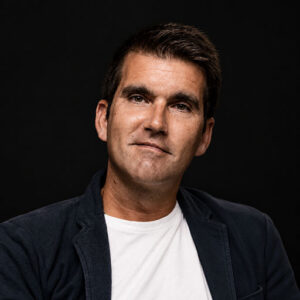
Marcus Mizelle opens his conversation with Roxy Shih on a compliment that doubles as a trap: the trailer for Beacon looks like a big-budget movie.
Roxy doesn’t take the bait.
“It’s not.”
Two words, and the polish falls off. Behind the slick, weather-beaten images is something far less glamorous: the North Atlantic coast of Newfoundland, 80 mile-per-hour wind, fog thick enough to kill a day, icebergs, ATVs hauling crew to set, and a lead actress cast 48 hours before the camera rolled. Roxy calls it “the most difficult film I’ve ever made in my life.” Then, dry as anything: “And I’ve done a lot of movies.” It’s not a flex. It’s the sound of someone who had to keep a production upright while it kept trying to fall down.
The Movie That Got There First
Roxy doesn’t have the prodigy origin story. No backyard camcorder. No straight line to a festival premiere. She went to university to study sociology and, by her own telling, half-wanted to be a flight attendant before deciding she was too short to qualify.
The turn came in a humanities course. She was nineteen, watching Jacques Demy’s The Umbrellas of Cherbourg (Catherine Deneuve, Michel Legrand’s score, every line of dialogue sung) in a language she didn’t speak.
I was just the only one in the hall crying my eyes out.
It’s better than the prodigy version because the feeling arrived before the understanding. The film reached her through color and music and rhythm before she had any vocabulary for what it was doing. What it left behind was a taste, not a career plan. She’s drawn to filmmakers who commit to a formal idea and trust the audience to feel their way through it. Singing every line of dialogue shouldn’t work. It wrecked her anyway.
Coming Up the Hard Way
She came up without film school, which left her with imposter syndrome she fought “tooth and nail” as a woman, Asian, and queer in the industry before inclusion was a conversation anyone was having out loud. She made something like seven micro-budget features, said no to almost nothing, and learned to be scrappy. Her path into directing ran through the cutting room and the production office: first an editor, then a line producer, then a director. That sequence matters later.
A Hired Director on Someone Else’s Script
Here’s a detail worth getting right: Roxy didn’t write Beacon. The script is by Julio Rojas. She came on as director, pitched for the job, and won it. “This tickles all my receptors,” she says of reading it. The project carried the working title Atlas before it became Beacon, and it landed at Tideline, a newer banner tied to Fox that backs edgier, festival-minded films. Producer Neil Elman had been circling Roxy for years, waiting for the right script to share.
The right script was a pressure chamber, exactly the kind of room she likes. Emily, a young sailor played by Julia Goldani Telles, shipwrecks off the coast of Chile and washes up at a remote lighthouse. Its keeper, Ismael (Demián Bichir), an older man living alone at the end of the world, pulls her from the water. He stitches her wounds, nurses her back, and can’t, or won’t, say when the storm will lift enough for anyone to reach them. Is he her rescuer or her captor? She can’t tell. Before long, he’s asking the same question about her. Two people, one location, a standoff where help and threat keep trading places.
She and Marcus trade The Shining as common ground, the particular horror of being trapped with another person while your own mind turns. “Who’s gaslighting who?” she asks. That question is the film’s whole engine. The fear isn’t only that someone might be dangerous. It’s that the person deciding what danger means might be wrong. Genre, for Roxy, isn’t an escape from that fear. It’s a way to hold it still long enough to look at it.
When the Shoot Became the Same Problem
The contained logic didn’t stay on the page. The production started behaving like the movie.
Newfoundland gave Beacon its scale and its menace, then spent the schedule taking both back. Wind ran 60 to 80 miles an hour, not atmosphere but a logistics problem. Fog erased visibility. The terrain was dangerous enough that crew rode ATVs to set, and at one point the Coast Guard shut them down. An 18-day schedule lost two days to weather, leaving roughly 15 to shoot a 95-page script. Roxy did the math out loud and didn’t love the answer.
Then the casting nearly took the whole thing down. “I casted my lead actress 48 hours before production,” she says. Actresses fell out the week before the shoot. A freak storm swallowed the island. And, separately and absurdly, a roughly $25 million gold heist at Toronto Pearson tangled up the port of entry, stranding the incoming cast in transit. The actors landed at 11:38 p.m. and were on set at 8 a.m. No fittings. No camera tests. Straight into the work.
The Tool Belt
A two-hander has nowhere to hide a weak center. Roxy was on the floor of her place crying that week, by her own account, while her DP talked her down: “You’re gonna have your Aragorn situation,” the way Viggo Mortensen came in at the last minute to anchor The Lord of the Rings. Which is exactly what happened. The right actress arrived inside 48 hours and held the film.
“Your tool belt is unique to yourself,” Roxy says. Editing taught her what a scene needs once the day is gone and the footage is all you have. Line producing taught her where money, time, and human stamina break. Micro-budget work taught her that limitation isn’t a personality; it’s something you manage. None of that looks impressive on a poster. All of it is why Beacon exists.
The Wound Is Real, Just Not This Film
The interview keeps circling Roxy’s mother, and it would be easy to fold that into Beacon and call the film personal. It isn’t. Beacon is Julio Rojas’s script and a directing job she pitched for. The mother-daughter material belongs to her own writing, a film in development called Mo, the word for monster in Chinese.
A director friend once told her that every filmmaker is working through a single wound, and that the day they heal it, the work stops being great. Roxy’s wound is the gap between a daughter of immigrants and her mother, two women raised in different cultures, misreading each other’s strength. A lot of films in that space fantasize about the mother finally apologizing. Roxy describes the opposite: now she wants to apologize to her mother for how badly she was misunderstood.
That reversal has the same architecture as her thrillers. Certainty gives way. The person you thought you’d figured out turns out to be carrying more than they ever said.
The Email at Michaels
The Tribeca news arrived in the least cinematic place imaginable. Roxy had just taken up crocheting and was at a Michaels, hunting for yarn, when her producer started blowing up her phone. She picked up annoyed (what do you want) and Neil told her to look at her email. The festival had written about how much they loved the film. Her first feature at an A-list festival.
She sat in her car in the parking lot and ugly cried.
No red carpet, no industry office. Yarn, a craft-store lot, and a body finally catching up to everything the production had asked of it. The episode takes its title from the line she offers as parting wisdom:
If you let the light within you shine, you give others permission to do the same.
After the wind and the heist and the 48-hour scramble and the floor-crying, it lands differently. It doesn’t tidy any of it up. The full conversation is worth hearing for the timing alone, the speed of Roxy’s pivots between bluntness and open feeling, the dry comedy a written piece can’t quite capture. Two words at the top of the episode tell you everything about her register. “It’s not.”