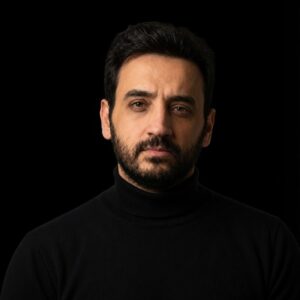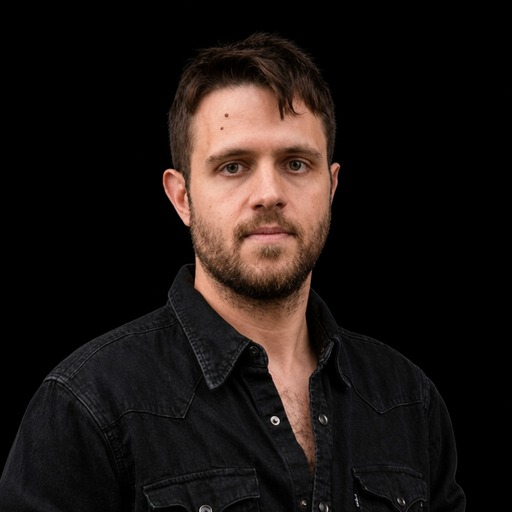
Nathaniel Lezra’s Roads of Fire won Best Documentary Feature at the 2025 Santa Barbara International Film Festival, and it began the way many of his films do: he walked out of his New York edit suite and the story was standing in the street.
It’s not that there’s a single broken system. It’s that there is no system.
A Film That Found Him
Lezra was finishing a previous documentary, about the mental health of teenage Ukrainian refugees, when he started seeing walls of people in midtown Manhattan, migrants bused into a city whose shelter system was overwhelmed. Confronting his own ignorance of the situation, he embedded first with the volunteers, discovering that a tiny web of roughly seventy-five small organizations was catching some two hundred thousand new arrivals, with little meaningful support from the city. His entry point was Adama Bah, a humanitarian fixer who is often the first call a newly arrived asylum seeker makes, and whose own story is staggering: detained as a teenager after being wrongly suspected in the post-9/11 panic, she emerged to become one of the city’s fiercest immigrant-rights advocates. Through her he met dozens more volunteers, then hundreds of asylum seekers, and finally Maria Pascal, an Ecuadorian mother rebuilding her life in New York with her two sons, who became the film’s anchor. What started as a portrait of volunteers and the people they catch grew into something far larger and three-stranded: the humanitarians, the asylum seeker, and a human smuggler.
Following the Road Backward
Here’s the stance worth drawing out, because it’s the film’s real discovery. Every political argument about immigration happens at the endpoint, the border, the crossing, the line of tired people on the news, as if the journey began there. Roads of Fire insists the journey, and the catastrophe, begins the moment a person leaves their doorstep, and that what happens in between is not chaos but a brutally efficient market. To show it, Lezra followed Maria’s path backward to Colombia. He could not enter Ecuador (in the exact window he planned to shoot, the president dissolved the National Assembly, an opposition candidate was assassinated, and the economy collapsed, and the embassy warned he would likely be kidnapped at the airport), so he routed around it. Because a visibly foreign journalist would have endangered everyone, a local fixer boarded a clandestine smuggling bus through guerrilla territory, embedded with a family of Venezuelans, and emerged with permission to follow them on foot toward the Darién Gap, the cartel-controlled jungle that is the only land bridge between the continents.
What that footage reveals is the film’s argument made flesh: the migrant catastrophe is, underneath everything, an extraction economy. Lezra’s film puts the human-smuggling industry at roughly forty-two billion dollars, and follows a once upper-middle-class family (someone in it had been a doctor months earlier) as they bankrupt themselves selling their house, their car, everything down to the paint on the walls, only to be charged again at every checkpoint by police, smugglers, armies, and gangs. By the time such a family reaches the border, stripped to nothing, they are indistinguishable from everyone else in the line. The person you might dismiss as a faceless migrant, Lezra suggests, is the financial survivor of a gauntlet you never imagined. The peril does not end at the line, either. The Venezuelan family became lost in the jungle and out of contact for months, leaving only harrowing voice messages, before the filmmakers learned they had reached Mexico City safely and applied for asylum there. Maria’s own path ran through a detention in El Paso and a bureaucratic snare the film captures in real time: told she was protected once she signaled an intent to apply for asylum, she was never clearly informed of the narrow window in which she actually had to file.
There Is No System
Which leads to the reframing that gives the film its spine, and which Lezra is careful to present as a corrective rather than a slogan. The “broken immigration system” that politicians fight over, he contends, is something of a fiction, because there is no single system to break. Asylum and immigration are different things; the city housing authority, the shelters, ICE, asylum attorneys, and immigrant advocates are all distinct, clashing bureaucracies, and what migrants fall through is the gap between them. His hope, stated plainly, is modest and practical: that the film becomes one element in a conversation that might eventually move resources, that an arriving asylum seeker might one day get a work permit in a day and a housing voucher in a month, becoming self-sufficient, rather than costing tens of thousands of dollars in warehoused limbo. He is not naive about a film’s limits. He has reason for the hope, though: his earlier Ukraine documentary screened for thousands of mental-health and policy specialists at a global conference and drew a written acknowledgment from the World Health Organization about its contribution to the conversation on refugee trauma. He simply believes a film can move a conversation an inch.
The Form Does the Moral Work
That belief shapes how the film is made.
Lezra cites Joshua Oppenheimer’s The Look of Silence, even more than The Act of Killing, as the work that rewired him, for the way Oppenheimer turns interviews into scenes in which the interviewer is also a character.
It’s structured as an interview, but it’s a scene.
So Lezra shoots his own interviews on location, inside the participants’ world, and casts himself as a deliberate proxy for the viewer’s ignorance, refusing the talking-head documentary’s quiet promise to explain these people to you from a safe distance. The conviction underneath is that empathy is not information; you cannot be argued into caring, you have to be taken somewhere. The film belongs in conversation with two works he doesn’t name: Gianfranco Rosi’s Fire at Sea, which anchors a migration crisis to the local structures that absorb it, and Rebecca Cammisa’s Which Way Home, which walks the perilous road north alongside those traveling it.
Why This Filmmaker
None of this is abstract for Lezra. He is Spanish-American, and his grandfather, a Jewish Moroccan Spaniard, was imprisoned by Spanish fascists as a teenager, bribed a guard, smuggled himself out in the back of a car to Tangier, and rebuilt a life from nothing. The knowledge that the line between the comfortable and the fleeing is one bribed guard, one dissolved constitution, one collapse away is, he says, in his family’s DNA. He made the film lean and scrappy by necessity as much as instinct, with a camera on his shoulder, because the documentary market had swung from a strike-era glut to a chill in which, as he puts it, no one was buying anything and streamer slates were programmed years out. He had sold his Ukraine film to a major network off a single pitch; Roads of Fire, by contrast, he built independently and finished only after picking up post-production financing at Sundance. The whiplash, feast to famine, has left many filmmakers he knows ready to quit. His answer is the one the whole film embodies: point the camera at what’s right in front of you, and trust that closing the distance between those who endure and those who merely watch is still worth doing.