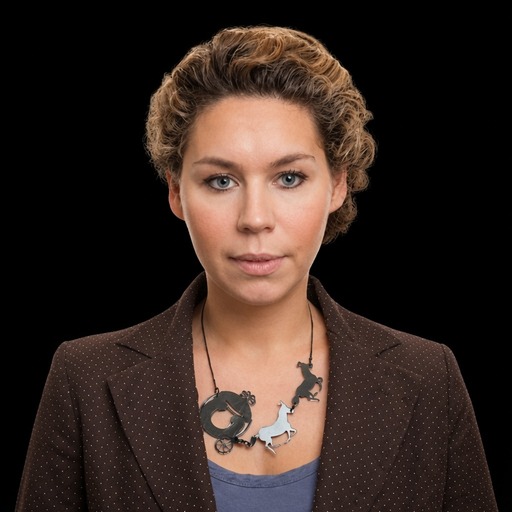
Ania Trzebiatowska has spent her career on the other side of the submission portal. Polish by birth, she ran the Off Camera festival in Krakow for over a decade, headed acquisitions at the New York sales company Visit Films, programs documentary features for Sundance, and founded the Sands International Film Festival, a three-day showcase in St. Andrews, Scotland. The episode title names three faces of her work, craft, responsibility, intuition, but her real argument is that they are one thing.
It was still curation. It was just curation with more of a business side of things in mind.
One Act, Many Costumes
That line is one she still quotes from Ryan Kampe, who hired her into acquisitions despite her having no sales background. It is the key to her whole path. Running a festival, buying films for a sales agent, programming Sundance docs, founding a tiny Scottish showcase, even just telling a friend about something they haven’t seen, are all the same gesture: I love this, and I want to put it in front of you. The contexts change, the spreadsheets change, the act does not. Curation, for her, is simply the discipline of sharing what moves you, and she calls it good for the soul. The Scottish festival was almost an accident: raised in the UK, she had studied in Krakow and wanted a part-time European project for the quiet months after Sundance, when her academic sister forwarded a Guardian ad for a curator to build a festival at the University of St. Andrews. She got it, knowing no one there, and shaped it deliberately small, a weekend where you can see every film and attend every event, co-curated with students, now founded in partnership with the Russo Brothers’ studio AGBO and entering its fifth year. She does not want it any bigger; she does not like to overwhelm.
The Marketplace, From the Inside
Because she has worked both the festival and the sales side, the anxieties filmmakers obsess over look different to her. Take the dreaded Vimeo view count. Filmmakers panic when a screener shows zero plays, certain no one watched.
If you’re a filmmaker, I’m your biggest fan. I really want you to succeed.
She promises every submitted film is seen by one or two programmers, and that third-party players, an Apple TV feeding a projector, simply don’t register on Vimeo’s counter. She once told a despairing filmmaker she had watched his film herself and offered to be quizzed on it. The deeper reframe comes when she pushes back on the very idea of “marketplace success.” A distribution deal, she notes, is brutally hard right now for any film, full stop, and foreign-language titles are nearly impossible to sell in the United States, not from malice but from the numbers buyers live by. Recognition runs on a slower clock: a film travels festivals for a year, then lands on a streamer, and more and more filmmakers self-distribute rather than wait, which she deeply respects. She learned all of this at Visit Films, whose curated slate of first and second features (an early home for a film like It Follows before it exploded) she had admired for years. Acquisitions, she admits, can be rough on a film lover: buyers ask for something, you deliver it, and they have moved on overnight, so you grow a thicker skin. There is a middle ground she believes in, on both the buying and the programming side, where you push an audience a little without dragging it somewhere it isn’t ready to go, because no one wants to be challenged every waking minute. What a filmmaker experiences as a closed gate, she experiences as an act of love performed under brutal constraint. She is also quick to note that most recent Oscar-nominated films were Sundance-supported, so the work does travel, if rarely on the timeline anyone wants.
Where Responsibility Enters
And the constraint is real. Sundance’s nonfiction slate is roughly thirty films, ten in the U.S. competition, ten in the world competition, plus some premieres, against many hundreds of submissions. Every yes is also a hundred no’s. The job, she insists, is not to chase an agenda or a hot theme; the team responds to what arrives, and the themes only emerge once the whole program assembles and you notice what the country is thinking about. The harder discipline is balance. She will always make room for the unbearable necessary film, like Mstyslav Chernov’s report from the ongoing war in Ukraine, because the moment a festival stops showing those, it has decided not to care. But she insists, just as fiercely, on room for work that is humane, entertaining, and emotionally alive. There are five nonfiction programmers who select together, so she sees the best of the fiction side too, though documentary is her home. Knowing who you work with helps, she says, but it guarantees nothing; what helps more is doing your homework. Flag your film by email, note that an updated cut is coming so the next programmer to watch sees it, and above all research what a festival actually plays, so you don’t spend a hundred dollars submitting a television documentary to a place that was never going to be its home.
The Philosophy in One Film
Her favorite proof is a documentary she championed at Sundance, where it won the U.S. Documentary Audience Award, and then brought to her own festival in Scotland.
Tony Benna’s André Is an Idiot is, on paper, a film about a man dying of colon cancer he could have caught with a colonoscopy. In practice it is hilarious, tender, and life-altering, because its real subject is never the disease but the gloriously exasperating human being inside it. It is her answer to anyone who claims nobody wants to watch a film about cancer: not true, and anyway it depends entirely on the film. The same instinct, she notes, is what let a hard film like Gleason, the wrenching ALS documentary she saw premiere years earlier, hold an entire room that could not look away. Character is what carries a difficult subject. Her film sits beside two she doesn’t name: Kirsten Johnson’s Dick Johnson Is Dead, which turns a father’s approaching death into something playful and luminous, and Won’t You Be My Neighbor?, proof that audiences will embrace warmth and depth over the merely topical.
What Curation Is For
This is where the title’s three words finally collapse into one. The intuition she chases across six films a day for weeks, the simple hope of being surprised and moved, is just curation listening for the thing worth passing on, and it is inseparable from the craft of recognizing it and the responsibility of choosing. Her advice to filmmakers follows from the same place: do your research, know what a festival actually plays before spending a hundred dollars to submit, be clear about what you’ve made, and ask for notes only from people who understand the film you intended rather than the one they would have made. It is the same trap she watches filmmakers fall into on juries, judging a film by how they would have done it rather than by what it is actually trying to be. The week Robert Redford died, she found herself returning to what he built Sundance for, making space for stories and people who would otherwise go unseen. To curate, in her hands, is not to guard a gate. It is to keep insisting, against a market that forgets and an algorithm that miscounts, that someone is watching, and that what you love deserves to be seen.