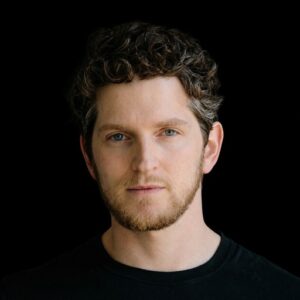
This year, Thom Powers and his team are weighing nearly a thousand documentary submissions, a record, for the roughly twenty-five slots in the Toronto International Film Festival’s documentary section. He thinks about those decisions, he says, from the moment he wakes until the moment he falls asleep, carrying the weight of them all day long.
The quality that I’m most looking for is to be surprised.
Three Lives in Film
Powers grew up in suburban Detroit, a place where it felt like the real world was happening somewhere else and books and films were the way to reach it; documentaries, he says, eventually outpaced fiction in his affections like a racehorse pulling ahead. He describes his career in three acts: seven years in publishing, ten as a documentary filmmaker (he produced the Cinemax-aired Brass and the HBO film Private Dicks: Men Exposed), and the last twenty as a programmer. Having made films himself, he notes, means he knows what is at stake when someone submits one. The pivot came in his late thirties, when he realized that the part of filmmaking he loved was not the shooting or the editing but the showing, getting the right people into a theater to watch a finished film. In 2005 he turned that instinct into Stranger Than Fiction, a Tuesday-night series at New York’s then-new IFC Center, built to solve a problem he kept seeing: filmmakers would return from Sundance or Toronto with a film and nowhere left to show it, often forced to four-wall a theater out of their own pocket. He paid them an honorarium instead. That impulse grew into a programming life that now spans TIFF, the Miami festival, the Montclair Film Festival he co-founded with his wife, and DOC NYC, the country’s largest documentary festival, which he led as artistic director for its first twelve years before handing the reins to Jay LaPlante and narrowing his own role there to its Visionaries Tribute.
The Gatekeeper Who Isn’t One
Here’s the stance worth drawing out, because the episode’s own title calls Powers a gatekeeper, and almost everything he describes quietly proves he is the opposite. A gatekeeper’s job is to keep things out. What Powers actually does is connect: this film to that audience, this unknown director to the right publicist, this surprising small movie to a buyer who doesn’t yet know they want it. Consider what he did for Beba, Rebecca Huntt’s debut self-portrait, made by a filmmaker with almost no industry contacts. Powers didn’t merely select it. He recommended a publicist and a sales agent, called distributors before the festival to tell them to watch for it, and the film sold to Neon. That is not gatekeeping. That is advocacy. The gate is the wrong metaphor entirely, and the better word is matchmaker.
Why He Won’t Sell the Myth
This reframes the single most clarifying thing he says.
I don’t like to over-mythologize the festival space as a place where your film is going to get bought. It has always been a minority experience.
The myth of the festival is the myth of the gate: you get in, you get anointed, you get rich. Powers dismantles it, not out of cynicism but because the real value lies elsewhere. The festival, he insists, is context, the audience response and critical reaction that let a film be seen for what it is. He distinguishes carefully between films that are so commercial they don’t even need TIFF, and films that need the platform to show distributors how an audience actually responds. He points to a title that drew a strong festival reaction and was then picked up by MUBI, something he suspects would have been far harder for a distributor to act on without that public, critical context. The festival, in his telling, is not a door you pass through. It is a room where a film and its people can finally find each other.
How a Thousand Becomes Twenty-Five
The mechanics are humbling. Of a thousand submissions, he reckons more than half simply are not ready for a platform with TIFF’s expectations, which leaves around four hundred films of real substance competing for those few slots. From there, the deciding quality is surprise. A film that covers familiar ground in a familiar way, however competent, struggles, while the one that reorders what he thought he knew leaps forward. He tells the story of putting on a little-known debut at 9:30 at night just to clear his queue, and being so gripped that, halfway through, he was silently begging the screen not to ruin it. He also programs for balance: he could fill all twenty-five slots with urgent human-rights films, or all twenty-five with crowd-pleasing celebrity docs, and he argues that doing either would betray the section. The art is in the spectrum. He does not do it alone, overseeing the TIFF Docs section with a team of nearly twenty programmers, several with regional expertise spanning Latin America and Eastern Europe, while higher-profile titles (recent festivals have featured documentaries on Lil Nas X, Elton John, Paul Simon, and an opening-night film about John Candy) play in the Gala and Special Presentations slots. He is mindful, too, that TIFF’s fifty years of audience expectation cut both ways: a film can be reviewed more harshly there than at a smaller festival simply because the bar is set so high. On length, he offers a programmer’s rule of thumb, that seventy to ninety minutes is the sweet spot, since under seventy can feel slight and over ninety starts testing an audience’s patience.
What He’s Really Guarding
It is no accident that his all-time favorite documentary is Hotel Terminus: The Life and Times of Klaus Barbie, Marcel Ophuls’ Oscar-winning, four-and-a-half-hour reckoning with a Nazi war criminal and, just as damningly, with the many ordinary people who sheltered him.
It is a film about the diffusion of responsibility, about how evil survives through quiet complicity, and its moral seriousness is a long way from the red-carpet galas. That same conviction shaped his most charged recent selection, The Bibi Files, Alexis Bloom’s documentary built from leaked interrogation footage tied to the corruption case against Benjamin Netanyahu, a legally contested film he premiered carefully as a work in progress, working with producer Alex Gibney and the team to weigh exactly what to announce and what to let audiences discover, knowing it would generate headlines. Powers belongs to a lineage he doesn’t name: the discovery that produced Searching for Sugar Man, the surprising small film that becomes a festival sensation, and the towering moral inquiry of Claude Lanzmann’s Shoah, the kind of work his favorite film sits beside. His deepest lesson, learned at frustrating filmmaker mixers decades ago, where everyone kept glancing over each other’s shoulders hoping to spot a funder who had wisely stayed away, is that the people in the room beside you, not the financiers you’re straining to reach, become the relationships that endure, the ones who share information and equipment and, eventually, careers. The title calls him a gatekeeper. The job he describes is the reverse: having given up making films of his own, he has devoted himself, through the festivals, the Pure Nonfiction podcast, and his radio work, to making sure other people’s films are not left floating alone in space.