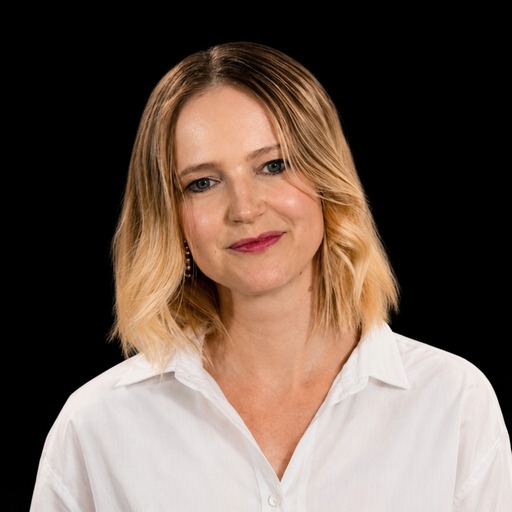
Janicke Askevold never went to film school. She made her first feature, Together Alone, with friends during the COVID lockdown, no budget, thirteen days, on an island outside Oslo, the actors writing their own script, simply to force her way through the industry’s front door. A few years later, Solomamma became the first Norwegian film selected for Locarno’s main competition since 1975, premiering to a 2,800-seat house as a contender for the festival’s top prize, the Golden Leopard. It was the first festival she had ever attended. Before directing, the Paris-based Norwegian worked as an actress and model, with credits including China Salesman and My Way, and spent time in Los Angeles chasing acting work, so she knows from the inside how tough that road can be.
I would tell myself to jump in and don’t be so scared. Write your story and send it out.
A Family First, the Truth Later
Solomamma follows Edith (Lisa Loven Kongsli, of Force Majeure), a journalist in her forties who chose single motherhood through an anonymous sperm donor and has spent five happy, exhausting years raising her son. When the donor’s identity surfaces, a successful game developer named Niels (Herbert Nordrum of The Worst Person in the World), Edith seeks him out under the false pretext of interviewing him about his company. The calculated encounter deepens into a genuine connection, and she sinks further into a web of lies that threatens the fragile life she has so carefully built, her own mother’s failing health pressing in at the edges.
The Refusal to Wait for Permission
Here’s the stance worth drawing out, because Askevold’s life and her heroine’s are organized around the same impulse: a refusal to wait for permission. Askevold made a feature with no training, no money, and no one’s blessing, and the advice she would give her younger self is simply to write the story and send it out sooner, to stop waiting to feel allowed. Edith embodies the same refusal in a different key. She did not wait for the conventional prerequisite of a partner before having a child; she built the family first and would deal with the rest later. The film is pointedly timely about this, arriving in the wake of Norway’s 2020 law change that finally permitted single women to conceive via donor at home. Before that, as Askevold explains, they had to travel to Denmark, an expense and an ordeal that carried its own quiet message that doing this was somehow not allowed. Solomamma lands at the precise moment the permission was granted, and asks what a woman does with a freedom so newly won.
Where the Refusal Curdles
The film’s intelligence is to locate the exact point where that liberating refusal turns into something darker.
It was very important that we felt that chemistry between them, and that we’re rooting for them, even though the situation is very wrong.
Edith does not merely decline to wait; she lies, insinuating herself into Niels’s life under a fabricated premise. The drama is the cost of that inversion, of acting first and reckoning with the truth afterward. Underneath it sits a specific, devastating wound. Edith grew up with the void of a father who left, and her deepest fear is that she has handed her son the same emptiness by giving him no father at all. The film’s quiet correction is that the two are not the same thing: a child who never had a father does not mourn one, and the absence Edith dreads is really her own. Her deceit, then, is the cost of confusing her wound with her child’s, and the “search for self” in the logline is literal. She is chasing the father-shaped hole in her own history through her son’s donor.
Grounded in Research, and in Her Own Life
What keeps all this from being thesis-driven is how lived-in it is. Askevold built Edith from extensive research, interviewing solo mothers across Norway about why they chose this path, what they feared, and what they were proud of, and discovered beneath the pride a fear of not being enough that she thinks any parent recognizes. The research also reassured her: studies suggest children of solo parents are at least as happy and fulfilled as any other, because what matters most is the attention and love they receive. She drew, too, on her own winding path through single motherhood and a blended family. The premise itself came from a real acquaintance who found her donor on social media and began dating him, building the relationship in reverse. Crucially, Askevold refuses both the celebration and the condemnation the subject invites, letting Edith be capable and loving and also, at times, deceitful, a woman in moral grey territory rather than a lesson.
The European Inheritance
Her cinematic reference points place the film in a particular European lineage.
The one she says she talked about most while making Solomamma is Maren Ade’s Toni Erdmann, that daring, funny, uncomfortable study of a woman’s life and the people who intrude on it. Her first movie crush was Billy Wilder’s Sunset Boulevard, and her foundation, formed in a Paris theatre school, runs back through German Expressionism, Fritz Lang’s Metropolis and Murnau’s Nosferatu. Her film belongs beside two she doesn’t name: The Kids Are All Right, in which a donor’s arrival unsettles a family built without him, and The Lost Daughter, that unflinching portrait of maternal ambivalence and a woman’s buried self.
The Long Road, Walked Late
The making of it was its own act of patience: a synopsis written alone in a Paris apartment, a pitch to the Oslo company Bacon, development money from the Norwegian Film Institute, two co-writers, a year with one screenwriter and then a fresh pass by another to find the tone, a casting process in which she met each lead separately before a chemistry test that made her weep because the connection between them could not be faked, a proof-of-concept pilot shot as part of the production-financing application (an opportunity, she stresses, that the Film Institute extends rather than demands), and a tightly prepped twenty-five-day shoot in long Norwegian summer light, the sun barely setting, the workdays held to a brisk eight hours for budget reasons, with a co-star not yet five years old who could only manage so much. There was also an editing room she calls the place you can make a whole new film. The score came from a Lithuanian duo, part of a co-production spanning Latvia, Lithuania, Denmark, and Finland, whose unexpected, culturally distinct sensibility she fell for instantly (her fiance, a music supervisor, helped translate her vision into words), and the sound design, from a collaborator of Ruben Ostlund’s, played with the textures of water-ringed Oslo. Doing it a little older, she says, meant she never once took the opportunity for granted. The film ends with Edith arriving at a hard-won peace, realizing she never needed to bend to anyone else’s idea of a family, and it has since gathered honors well beyond its premiere, from a Locarno jury prize to a later European award. The lesson of the whole arc, from lockdown to Locarno, is the one she keeps returning to: do not wait to be chosen. Write the thing, and send it out.