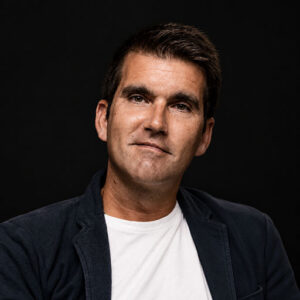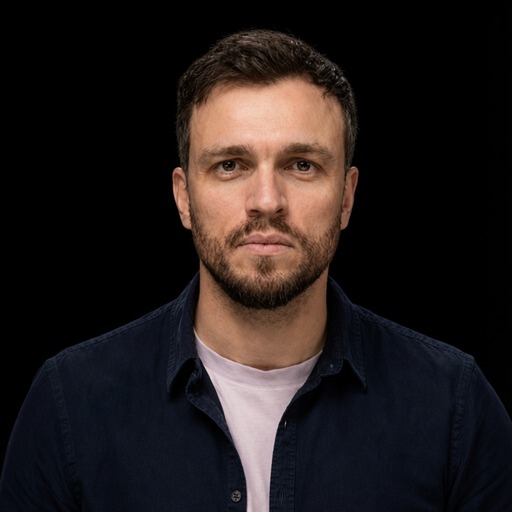
Panopticon is the name of a prison design: one guard in a central tower who can see into every cell, while the prisoners can never tell if anyone’s actually watching. They behave anyway, just in case. George Sikharulidze took that idea and built a coming-of-age film on it, then pushed it one step further. What happens to a kid who grows up certain someone is always in the tower?
The kid is Sandro, eighteen and living in Tbilisi. The watcher is everything at once: God, the church, his football team, the whole country.
A Title Borrowed From a Philosopher
Sikharulidze found the word before he found the film. He was reading Foucault, who took that prison and turned it into a theory of how modern societies discipline everyone, not just inmates. One line stuck: visibility is a trap. He wrote it down at the top of the project and left it there, a reminder, through the five or ten years it might take to finish. The more Sandro fights to be seen and respected, the tighter the box gets around him.
It points at a specific place. Sandro is eighteen, living in Tbilisi with his grandmother, his mother gone to New York, his father about to leave for a monastery. When the father goes, he hands his son one last instruction: be good, because God sees everything. He erects the surveillance tower himself, then walks away, and everything that goes wrong for Sandro flows from that watching eye.
The Film That Made Him Want to Make Films
Sikharulidze didn’t grow up with a camera in his hand. He says so plainly. He wasn’t the kid shooting movies with his siblings. He didn’t think about filmmaking until he was about twenty, studying media at NYU and more interested in music than cinema. Then a film history class showed him François Truffaut’s The 400 Blows. It’s the 1959 French New Wave landmark about Antoine Doinel, a Paris boy with distant parents and an oppressive school who drifts into petty crime. Something clicked. He applied to film school the next year.
What hit him wasn’t technique, it was recognition. He grew up with both parents alive but absent, fending for himself. Truffaut’s abandoned kid felt like his own story told back to him. He keeps returning to one detail: the English lesson where the teacher makes the class repeat “where is the father.” It lands as comedy, because the French struggle with the “th.” It also lands as the whole film’s buried question. Truffaut grew up fatherless and later adopted the critic André Bazin as a kind of father, dedicating the film to him. That question, where is the father, runs straight into Panopticon.
What Honesty Costs
Audiences can forgive a lot of flaws, but they do not forgive dishonesty.
That conviction is the spine of how he works. He’ll tell you almost any film has flaws the director can name, except maybe The 400 Blows. But dishonesty is the one thing an audience feels and won’t pardon. So when he tried to write the father in Panopticon, he kept accidentally writing his own father, and pulled back because it felt too close. He found his distance in a real story instead. A friend from eighth grade had a father who left for a monastery and cut every tie to his family. Borrowing someone else’s true thing let him protect the emotional core, an estranged father and son, without putting his own father on the screen.
Religion as a Way to Belong
The film’s other engine is faith, and Sikharulidze comes at it from an unusual angle. Georgia is a deeply Orthodox country, but he grew up without religion; his parents never practiced. Around fourteen, he and his sister were the ones who started going to church. They even tried to bring their parents along, which is the reverse of the usual story. Looking back, he reads it as a search for belonging. In a society where being Orthodox is social currency, faith was a way to fit in.
That insight goes straight into Sandro. The moment the boy reveals his father is a monk, the tough kids grant him instant respect. He slips into the role of the good son, the son of a monk. The film watches him perform belief to belong, the same move its director once made. Sandro is no easy hero. He’s a voyeur and an exhibitionist, drawn toward radicalism. The women in his life keep modeling a gentler way of relating, one he mostly fails to return. Sikharulidze refuses to judge him. He presents the boy as a product of the tower, not a villain who chose his own cruelty.
A Director Who Removes Himself
For Panopticon, Sikharulidze made a deliberate stylistic choice: erase the director. He subscribes to the idea that the job is to serve the story. Here the story wanted no visible hand, no flourish announcing the auteur. He frames it with a line from his film school professor Eric Mendelsohn that he clearly treasures.
A director is like a tour guide. Your job is to take people to the top of the mountain to show them the view, but you are not the view.
He shot it with Oleg Mutu, the Romanian cinematographer behind 4 Months, 3 Weeks and 2 Days. The framing presses tight on Sandro, mimicking the feeling of being watched. The look is restrained on purpose. It holds back on the violence even as Sandro drifts toward radical groups, staying with the camaraderie that pulls him in instead. A boy who behaves because he’s sure he’s being watched, shot like he’s being watched.
Six Years, Four Countries
The road to the screen was long and procedural. As a Georgian film, Panopticon couldn’t be self-financed; Georgia doesn’t have the money. So Sikharulidze went through the European co-production machine, securing the local Georgian fund first, then partners in France, Italy, and Romania. The script came up through labs. A Cannes writing residency first, then Torino Script Lab and Torino Feature Lab, plus a long circuit of pitching platforms during the pandemic. He estimates the whole thing took five or six years from conception.
He’s candid about the cost of that grind. All those rooms full of opinions can sharpen a script. They can also wear it down. One of his takeaways: don’t sit on a script so long that you become a different person than the one who started it. The labs taught him to carry a 95-page story in his head while shooting wildly out of order, something a five-scene short never demanded. The lesson he keeps closest came secondhand from Jim Jarmusch, met briefly at a New York screening. Film school was worth it, Jarmusch said, but you spend years afterward unlearning what it taught you. The urge to unlearn is itself the sign that you found your own voice.
Eat the Popcorn
Sikharulidze is honest about the dread, too. Watching his own film at a DCP test, he cringed on every other frame. Marcus offers some consolation: even Adam McKay squirmed through a screening of Vice with Will Ferrell sitting right there. The fear never fully leaves. Sikharulidze quotes Kurosawa, asked late in life when he’d stop making films, answering that he’d stop as soon as he learned how to make them. The goal, both filmmakers agree, is to reach the rare screening where you can just sit back and eat the popcorn.
For now he’s bracing for Karlovy Vary’s Grand Hall and the Crystal Globe. The thing he’s most nervous about isn’t himself, it’s the crew and cast who waited two years to finally watch the film with an audience. The full conversation gets into the Foucault, the Truffaut, and as good a working definition of honesty in filmmaking as you’ll hear from a first-time director.