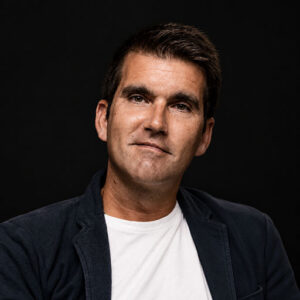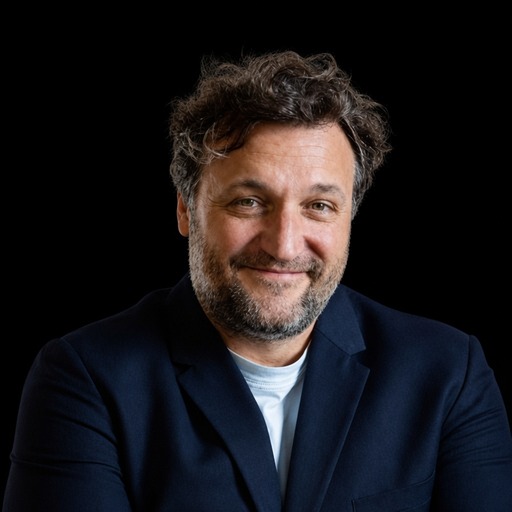
Celebration opens with a man hiding in the woods above his own village, watching a home he can’t go back to. It’s the end of the war, and the partisans down in the valley would shoot him on sight. He picked the fascist side, and lost. From up there, the film works backward through twenty years to figure out how he got to this tree line. How does an ordinary kid end up a man worth hunting? Bruno Anković’s first feature takes its time answering. It builds the case season by season, out of poverty, humiliation, and the false promises that found this boy when nothing else did.
The title is grim on purpose. The “celebration” is the fascist Ustaša briefly seizing power in 1941. Anković tells that story without flinching, and without making it look good.
The Haneke Film Behind It
Marcus opens with a quote: art’s job is to ask questions, not answer them. Anković names the author before the sentence is even finished. Michael Haneke.
It is the duty of art to ask questions, not to provide answers.
No surprise there, because Haneke is all over how Celebration was built. The film Anković points to is The White Ribbon, Haneke’s 2009 Palme d’Or winner. It’s a black-and-white story set in a German village just before World War I, where the children quietly punish the adults who preach values they don’t actually live by. Haneke called it a film about where evil comes from, religious or political. He argued that the repression of that buttoned-up Protestant village is what made the next generation’s fascism possible. Anković took that idea and pointed it at his own corner of the world. Haneke traced the roots of Nazism in Germany. Celebration traces the roots of Balkan extremism back to plain grinding poverty and the daily fight to get by.
How a Boy Becomes a Soldier
Underneath the history, the story is small and personal. Mijo is a poor kid in the Lika mountains. The film catches up with him in four chapters, one per season, from his childhood in the 1920s to the last days of the war. You watch his father do something cruel out of sheer poverty. You watch Mijo follow an official order to get rid of the family dog. The small humiliations pile up. Then right-wing ideology shows up offering him the two things nobody else will: a little hope for a better life, and someone to blame for everything that’s gone wrong. That’s the machinery Anković wants you to see clearly, the ordinary road from being ground down to signing up.
He built it from a novel he couldn’t shake, Damir Karakaš’s Celebration, working with screenwriter Jelena Paljan. What grabbed him was the way the region’s history kept bleeding through the private story of one family. It’s a place stuck in a loop of war and poverty and the stubborn hope that things might get better someday. And he’s clear that the loop isn’t only a Balkan thing. The same mechanics, he says, are playing out all over the world, then and now.
Three Actors, One Man
Time isn’t only the theme here, it’s the hardest thing Anković had to solve. Mijo is played by three different actors as he ages. Bernard Tomić is the grown man, with a teenager and a boy filling in the years behind him. The film checks in on him at roughly eight, fifteen, twenty-one, and twenty-five, each visit in a different season. Holding one character together across three faces and twenty years is the kind of thing that sinks a film. Anković leaned on his other influences to pull it off.
The seasons aren’t just there to make the film pretty, though they do. Anković has a harder reason. Out here, he says, the only thing that ever really changes is the weather. Spring comes, winter comes, and the people stay exactly the same. The young grow into the old, one generation hands its grudges to the next, and the whole thing runs again. The repetition is the point, and the turning seasons are how you feel it in your gut. He and his team actually named the four chapters at one stage. Mentors talked him out of putting the titles on screen, as too on the nose.
Two Croatian classics shaped the look of the village. The Birch Tree, a 1967 modernist film, gave him a mix of raw naturalism and stylized, painterly images borrowed from Croatian Naïve painting. It’s a story about a woman crushed by hard conditions and cruelty. Handcuffs, also known as Foxes, set a postwar village wedding under the eye of the secret police, thick with patriarchy and menace. Anković draws the line bluntly: the people in that film are foxes, and the people in Celebration are closer to wolves.
The Field, and Meeting Its Maker
The other touchstone goes back to when Anković was fourteen. He grew up in the coastal city of Split on a steady diet of Pasolini, Fellini, Visconti, and the Taviani brothers. Then he saw Jim Sheridan’s The Field, the 1990 drama with Richard Harris as an Irish farmer. The man will do anything to hold onto land his family has worked for generations. It’s a story about a hard life lived on the land, the kind of patriarchy you could set a century earlier without changing a thing. Thirty years later, reading Karakaš’s novel, Anković thought: this is The Field all over again.
Then the circle closed. Celebration got funding from the Doha Film Institute. At Qumra, the institute’s annual event, one of the mentors who sat down to discuss the finished film was Jim Sheridan himself. Anković got to tell the man what The Field had meant to him, over breakfast and a bit of Irish whiskey. Like Pawel Pawlikowski before him, who’d mentored the project at a Warsaw workshop, Sheridan turned out to be gentle and completely down to earth. The pedestal held up fine.
What’s in the Backpack
Anković came to features the long way around. He started as an editor at twelve, cutting home video, and studied editing. Then he spent years directing commercials, thousands of them, drawn to the narrative and comedic ones rather than the purely visual. A university professor, a well-known commercial director, saw something in him and handed him his first job. He still directs commercials today, and he’s unbothered by the split; a thirty-second spot, told right, is its own kind of one-minute movie. What drives him now isn’t products but ideas, stories that might change something in society.
His parting advice arrives as a metaphor he attributes to a Croatian director. Making a film, you set out with a backpack stuffed full, so heavy you can barely carry it. To reach the top of the mountain, you have to throw things out, scene by scene, until only what matters is left. Keep it simple, especially on a low budget, and know what you can do without.
We enter the future facing the past.
He closes on a line from the French poet Paul Valéry. Celebration is set a hundred years ago, but it keeps quietly insisting it’s about now. The full conversation is worth it for the way Anković ties Haneke, Sheridan, and the old Yugoslav classics into one argument about why the cycle keeps repeating. He gets into Paolo Sorrentino and Andrey Zvyagintsev, the Russian director whose anti-Putin stance has cost him his funding at home. And he’s good company: a first-time director who somehow ended up drinking whiskey with one of his heroes.