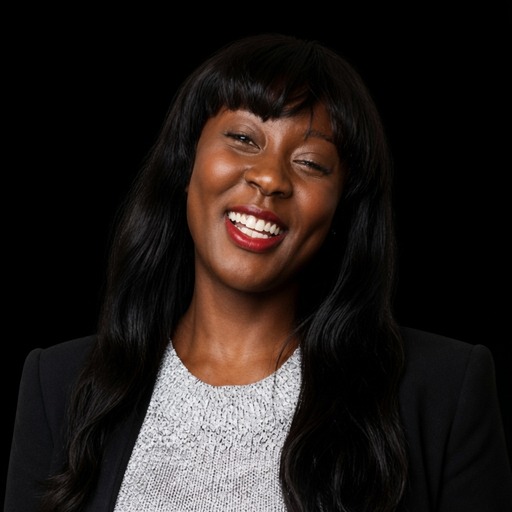
Ellie Foumbi made Our Father, the Devil for around $150,000, premiered it in the Biennale College Cinema sidebar at Venice, picked up an Independent Spirit Award nomination, and landed it on the Criterion Channel, which is where she shed a tear, because Criterion is the platform she watches religiously and seeing her own name at the top of it was the “I made it” moment. The film is a psychological thriller about a refugee named Marie, a head chef at a French retirement home whose carefully rebuilt life cracks open when a new chaplain arrives and she becomes convinced he’s a man from her violent past. The conversation around it is really about a longer project: how a writer learns to control her own story, on the page and in a career.
Foumbi came up as an actor and voice actor, a Cameroonian-born kid who moved to the United States and treated television as therapy, an escape from not belonging anywhere except in front of that little box. She noticed early that she fixated on dialogue, that she rewrote the endings of books she didn’t like at age eight. The instinct to seize the narrative was there before she had a word for it, and she traces it partly to the immigrant’s hunger to regain control of a story being told around her in a language she was still learning.
The Script Had to Marinate
Foumbi started writing Our Father, the Devil in 2015. It wasn’t working. She put it down, picked it back up in 2019, and used the years between as what she calls a marination process. She refused to shoot until the script was ready, and while it sat, she sharpened the rest of her toolkit on short films, workshops, and labs, including the Venice Biennale College.
This is heresy to a certain kind of emerging filmmaker, the one chasing the single Sundance-worthy short and then declaring shorts beneath them. Foumbi keeps making them, because every film is its own animal with challenges you can’t predict, and the only thing you can do between features is stay sharp.
The more shortcuts you take, the longer it’ll take you.
The lab circuit, she points out, runs on a brutal kind of competition: ten or twelve spots, hundreds of applicants, and the only question that matters is why you, why your perspective is fresh enough to be worth one of those seats. Learning to answer that, in a grant application or a synopsis, is the same skill as learning to write a scene. You strip it to the reason it has to exist.
A Hero Who Is Her Own Antagonist
The breakthrough on the film came with the ending, and it reframed everything. Foumbi realized that Marie is, in a sense, her own enemy: the thriller isn’t only Marie versus the man she’s hunting, it’s Marie versus what hunting him will cost her soul. Once Foumbi saw it that way, she could plant the clues that keep an audience guessing about who deserves what.
The clearest ancestor here is Andrea Arnold’s Red Road, the film Foumbi names as her main influence.
Arnold’s debut follows a Glasgow CCTV operator who spots a man from her traumatic past on her monitors and begins stalking him, the truth of their connection doled out a sliver at a time. The structural DNA is all over Our Father, the Devil: a woman, a man tied to an old wound, and a slow tightening vice in which the audience isn’t sure whether they’re watching justice or revenge assemble itself. Foumbi borrowed Arnold’s patience with withheld information, the confidence to let a viewer sit in unease.
Here’s the thing the film pulls off, and the stance worth making plain: it doesn’t just ask whether Marie should take her revenge, it implicates you in wanting her to. Foumbi locks you so tightly into Marie’s point of view that her vengeance becomes your wish, and then the film makes you feel what that wish costs. It’s the same move Roman Polanski made in Death and the Maiden, where a woman confronts the man she believes tortured her and the audience is left holding the moral bag. Foumbi isn’t interested in a verdict. She’s interested in your complicity.
Building Tension on a Micro-Budget
Foumbi is precise about the economics of the genre. A good thriller, she argues by way of the screenwriting teacher John Truby, is a hybrid of horror and detective story: the protagonist is solving for the truth while a series of escalating nightmares closes around them like a vice, each one engineered by an antagonist who appears to hold all the power. On $150,000 with a tight schedule, you can’t buy that tension. You have to write it. Foumbi’s working method on set strips every scene to its mechanics: who initiates it, what they want, what stands in the way, and how it feeds the larger picture. A scene a writer is in love with but that doesn’t serve the whole gets cut. Tony Gilroy’s rule that every scene needs a hook is, for her, not a flourish but a budget constraint. The setting itself came cheap and personal: the quiet French town belongs to the family history of her co-writer and producer Joseph Mastantuono, whose grandfather had been its mayor, and once Foumbi visited after the Venice workshop she knew immediately it was the place. The location does the production-design work that money usually has to, grounding Marie’s reinvented life in a real, lived-in quiet that makes the intrusion of her past land harder.
The performances carry what the money can’t. Marie is played by Babetida Sadjo, whom Foumbi had been circling since 2014, years before the script existed, after a mutual friend, a Belgian rapper Foumbi had known since her early days around international theater in New York, sent her a trailer and Foumbi couldn’t forget the actress’s eyes. The chaplain, Father Patrick, is played by Souleymane Sy Savané, who Marcus Mizelle recognized instantly: Savané was the lead in Ramin Bahrani’s Goodbye Solo, a film Marcus had gripped on years earlier. The web of connections is the kind that makes a small film industry feel like fate.
Personal, Therefore Universal
For all the talk of patience and craft, Foumbi’s guiding principle is simpler and more counterintuitive.
The more personal, the more universal.
A story filtered through one specific perspective, hers, an immigrant’s, an outsider’s, reads as unique precisely because no one else could have made it, and that specificity is what lets it land widely. The fear with a micro-personal film is always that no one will care about something so particular. Foumbi’s bet, and the film’s reception bears it out, is the opposite: the macro hides inside the micro.
She’s already moved on, two more thrillers and a sci-fi horror in development, because once a film hits Criterion it stops being hers and becomes the public’s, and a director who watched her debut get into the equivalent of Harvard has three more kids to raise. The patience that made Our Father, the Devil wasn’t passivity. It was the discipline to keep watering the plant, to know the difference between a project that’s stuck and one that’s simply still growing, and to wait until she could tell which was which.